
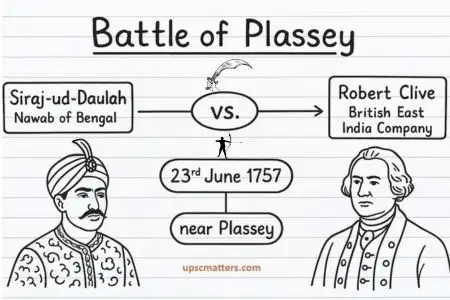
The Battle of Plassey, fought on 23rd June 1757, is one of the most defining events in Indian history. Often regarded as the turning point that marked the beginning of British colonial rule, this battle not only ended the independence of the Nawab of Bengal but also laid the foundation for nearly two centuries of British dominance in India.
For UPSC aspirants, understanding the Battle of Plassey is crucial—not just as a historical event, but as the starting point of political, economic, and social transformations that shaped modern India. This article provides clear and concise notes on the causes, key players, course of the battle, its outcomes, and the long-term impact, along with critical perspectives—all aligned with the UPSC syllabus.
Background of Battle of Plassey
- Decline of the Mughal Empire and rise of regional powers like Bengal.
- Importance of Bengal due to wealth and strategic location.
- After the death of Alivardi Khan, his grandson Siraj-ud-daula became the new Nawab.
- Conflict between the British East India Company and Nawab Siraj-ud-Daulah.
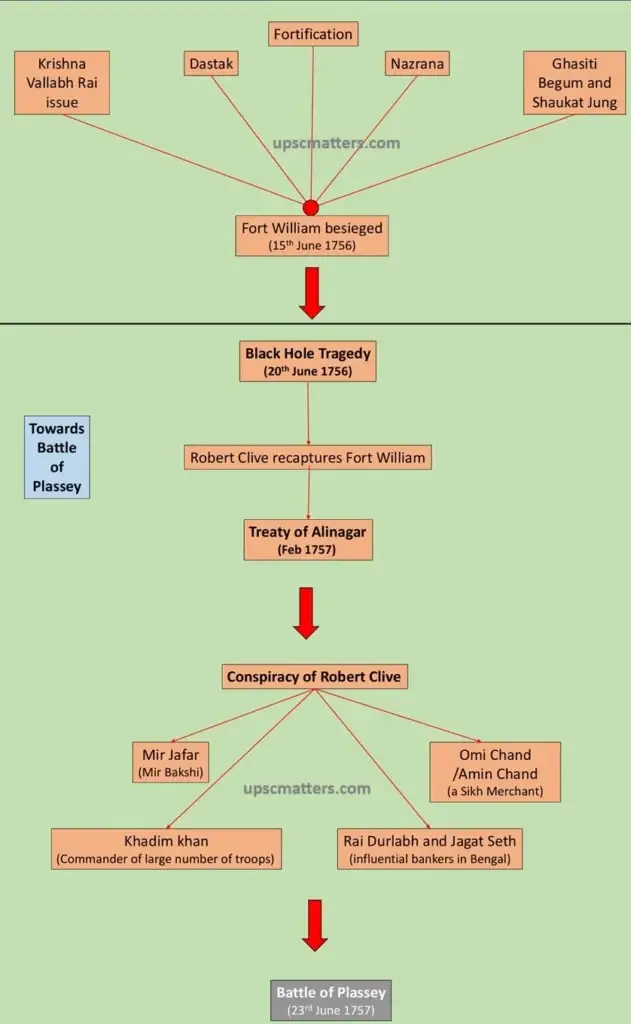
- British misuse of trade privileges (dastaks), fortification of Calcutta without Nawab’s permission.
- The incident of Black Hole of Calcutta (1756).
Black Hole Tragedy (20th June 1756)
What Was the Black Hole Tragedy?
- A tragic incident that occurred on the night of 20th June 1756 in Fort William, Calcutta.
- After capturing Fort William, the forces of Siraj-ud-Daulah, the Nawab of Bengal, allegedly imprisoned British soldiers and civilians in a small dungeon-like room.
- The room, called the “Black Hole”, was around 14 x 18 feet in size.
Key Facts
- Approx. 146 people (as per British accounts) were confined in the room overnight.
- Due to overcrowding, heat, and lack of ventilation, 123 people reportedly died from suffocation and heat exhaustion.
- Only 23 survivors remained by morning.
- The incident was publicized by John Zephaniah Holwell, one of the survivors and a British official.
Historical Controversy
- The exact number of people involved and those who died is disputed.
- Many modern historians believe that the figures may have been exaggerated by the British for propaganda purposes.
- Used by the British East India Company to justify their military actions against Siraj-ud-Daulah.
Aftermath and Significance
- The event shocked Britain and created a sense of urgency for revenge.
- Prompted the British to recapture Calcutta in early 1757 under Robert Clive and Admiral Watson.
- Served as a prelude to the Battle of Plassey (June 1757).
UPSC Angle: Why It’s Important
- Part of the causes leading to the Battle of Plassey.
- Illustrates how emotional narratives were used by colonial powers to justify expansion.
- Helps in understanding the role of propaganda in colonial history.
Treaty of Alinagar (February 1757)
Context / Background
- In 1756, Siraj-ud-Daulah, the Nawab of Bengal, attacked and captured Calcutta, leading to the Black Hole Tragedy of Calcutta.
- The British East India Company under Robert Clive and Admiral Watson recaptured Calcutta by bribing Manickchand in January 1757.
- To avoid further conflict and buy time, Siraj-ud-Daulah signed the Treaty of Alinagar with the British.
Date & Place: Signed in February 1757 at Alinagar (the name Siraj gave to Calcutta after capturing it in 1756).
Key Provisions:-
- Restoration of privileges: The Nawab confirmed the Company’s trading privileges as per the Farman of 1717 by Mughal Emperor Farrukhsiyar (e.g. duty-free trade).
- Fortification rights: Allowed the British to fortify Calcutta and other settlements.
- Restoration of factories: British factories and properties in Bengal were returned.
- Freedom of trade: Unrestricted trade was allowed for the British in Bengal.
Significance
- Helped the British gain legitimacy and consolidate power in Bengal.
- Gave Clive time to plan for the Battle of Plassey.
- Exposed Siraj-ud-Daulah’s weak position and growing dependence on the Company.
- Considered a strategic move by the British to prepare for their eventual domination.
Battle of Plassey (1757)
Date and Location
- Date: 23rd June 1757
- Place: Plassey (Palashi), on the banks of the Bhagirathi River, in Nadia district, Bengal (modern-day West Bengal, India).
Combatants :-
British East India Company-
- Led by Robert Clive
- Troop strength: ~3,000 (including 2,100 Indian sepoys, 900 European soldiers, and 100 artillerymen
Nawab of Bengal-
- Led by Siraj-ud-Daulah
- Troop strength: ~50,000 soldiers, 40 cannons, 300 elephants
Key Betrayers in the Nawab’s Camp
- Mir Jafar (Commander-in-Chief)
- Khadim Khan (Commander)
- Rai Durlabh, Jagat Seths (Bankers),
- Omichand (Merchant) supported the British conspiracy.
Battle Events
- Battle began early morning on 23rd June.
- A brief thunderstorm wet the Nawab’s gunpowder, rendering many cannons ineffective.
- Mir Madan/Mudan, a loyal commander of the Nawab, died during the battle—demoralizing the army.
- Mir Jafar and others did not join the battle, as secretly planned with Clive.
- The Nawab’s forces panicked and fled the battlefield.
- Siraj-ud-Daulah escaped but was captured and executed later by Mir Jafar’s men.
Outcome
- Decisive British victory with minimal casualties.
- The British lost fewer than 100 men, while the Nawab’s side lost over 500.
- Mir Jafar installed as Nawab, becoming a puppet of the Company
Significance / Impact of the Battle of Plassey
1. Beginning of British Political Control in India
- First major military victory for the British East India Company in India.
- Marked the end of independent Nawabi rule in Bengal.
- British moved beyond trade to territorial and political dominance.
2. Installation of Puppet Ruler
- Mir Jafar was made Nawab of Bengal by the British.
- He was heavily dependent on British support and acted in their interest.
- Set a precedent of using puppet rulers to control Indian states.
3. Massive Economic Gains for the British
- The Company and its officials received huge sums of money (plunder, compensation, gifts).
- Strengthened the Company’s financial base to expand its military and political influence.
- Funded future campaigns and consolidation of power in India.
4. Shift in Balance of Power
- Decline of regional Indian powers like Bengal.
- Rise of the British as a dominant foreign power.
- French and other European rivals lost influence in Bengal.
5. Foundation for the Battle of Buxar (1764)
- After Mir Jafar failed to satisfy British expectations, he was replaced by Mir Qasim.
- Tensions led to the Battle of Buxar, which further cemented British authority in Bengal and beyond.
6. Start of British Imperialism
- Plassey laid the foundation of British colonial rule in India.
- From a trading company, the East India Company began transforming into a colonial power.
7. Control Over Bengal’s Resources
- Bengal was the richest province; controlling it gave the British access to abundant revenue and resources.
- It became the economic base for British expansion in India.
8. Corruption and Private Trade
- British officials began indulging in private trade and corruption, accumulating personal wealth.
- Led to criticism and eventually regulatory acts from Britain (like Regulating Act 1773).
Criticism / Historical Opinions on the Battle of Plassey
This part is extra reading, only for understanding basis. So can be skipped if having time limitations.
1. “A Battle of Betrayal, Not Bravery”
- Many historians argue that the Battle of Plassey was not a great military victory, but rather a political conspiracy.
- Treachery by Mir Jafar, Rai Durlabh, and others ensured British victory without a major fight.
- Robert Clive himself admitted that more was achieved through negotiation than on the battlefield.
2. A Turning Point Through Corruption
- The British bribed Indian elites and traders to betray the Nawab.
- The Jagat Seths (bankers) and other Indian merchants played a decisive role in financing British interests.
- Reflects how internal divisions and greed among Indian elites facilitated colonization.
3. Plassey as the Genesis of Corporate Exploitation
- Seen by many as the first step in the transformation of the East India Company from a trading body to a colonial power.
- Historians like Romila Thapar and R.C. Dutt have criticized how a private trading company used deceit and manipulation to conquer a sovereign Indian state.
- Led to loot and drain of wealth from Bengal, causing economic decline.
4. Indian Nationalist View
- Nationalist historians (like Bipin Chandra) argue that Plassey marked the beginning of national subjugation.
- Emphasized that foreign rule was established through Indian disunity and betrayal.
- Used as a cautionary tale in later freedom movements to emphasize unity and resistance.
5. Plassey: Not a Full-Scale War
- From a military standpoint, the battle was brief (only a few hours) and lacked any large-scale combat.
- British army had only around 3,000 troops, yet won due to political manipulation.
- Hence, often not regarded as a ‘real battle’ in the conventional sense.
6. Criticism of Robert Clive
- Clive is sometimes credited as a military genius, but his methods involved bribery, misinformation, and secret deals.
- His post-battle enrichment led to charges of corruption in Britain; he was investigated by Parliament (though acquitted).
- Seen as the embodiment of early colonial exploitation.
Concluding View:
- “The Battle of Plassey was won not on the battlefield, but in the secret chambers of conspirators.” – This perspective reminds us that colonial conquest often began through diplomacy, betrayal, and manipulation, not just military might.
If you found this helpful, you might also like these articles:
📌 [https://upscmatters.com/indus-valley-civilization/ ]
📌 [https://upscmatters.com/buddhism-a-complete-guide-for-upsc-history/]
📌[https://upscmatters.com/advent-of-europeans-in-india-arrival-expansion/]
They cover key concepts that will boost your preparation! 🚀
📢 Stay Updated with the Best UPSC Resources!
Join our Telegram Channel for:
✅ Daily Current Affairs
✅ Important Notes & PDFs
✅ Answer Writing Tips
✅ Strategy & Motivation
📲 Click the link to join now: [https://t.me/upscmatters] or [https://t.me/ramsirnotes]
Don’t miss out on valuable updates! 🚀