
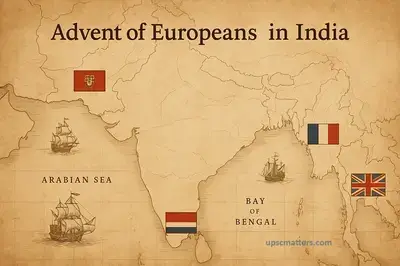
The advent of Europeans in India marked a major turning point in Indian history, laying the foundation for colonial rule. Driven by the lure of the spice trade and maritime dominance, European powers like the Portuguese, Dutch, British, and French began arriving from the late 15th century onward. This phase saw intense competition, establishment of trading posts, naval battles, and growing political interference—culminating in the eventual colonization of India by the British. Understanding their arrival, expansion, and impact is crucial for any aspirant of UPSC Civil Services Examination, especially under Modern Indian History.
Advent of Europeans in India
| European Power | Year of Arrival in India | First Factory | Exit from India |
| Portuguese | 1498 (Vasco da Gama) | Cochin (1503) | 1961 (Goa annexed by India) |
| Dutch | 1605 | Masulipatnam (1605), Pulicat (main base) | 1825 (transferred to British) |
| English (British) | 1608 (Surat) | Surat (1613 official factory) | 1947 (Indian Independence) |
| French | 1664 | Surat (1668), Pondicherry (major base, 1674) | 1954 (Pondicherry handed over) |
| Danish | 1616 | Tranquebar (Tamil Nadu, 1620) | 1845 (sold settlements to British) |
| Swedish | 1731 (minor presence) | Porto Novo (Nagapattinam area, Tamil Nadu) | Mid-18th century (withdrawn) |
Arrival of Portuguese in India
Background of Portuguese Arrival
Age of Exploration (15th Century)
- The 15th century marked the “Age of Exploration” in Europe, driven by the Renaissance spirit of inquiry, trade, and expansion.
- European powers (especially Portugal and Spain) were seeking direct sea routes to Asia, mainly to access the lucrative spice trade (pepper, cloves, nutmeg, cinnamon).
- Traditional land routes to India (via Persia and the Arab world) were controlled by Ottoman Turks and Arab merchants, making trade costly and politically sensitive.
Portugal’s Maritime Pioneering
- Portugal, under the leadership of Prince Henry the Navigator, invested heavily in naval exploration.
- Portuguese sailors explored the western coast of Africa, gradually moving southward in search of a sea passage to India.
- This effort was state-sponsored and strategically planned with a long-term vision for trade and religious expansion.
Treaty of Tordesillas (1494)
- Aimed at avoiding conflict between Spain and Portugal over newly discovered lands.
- Under this treaty, mediated by Pope Alexander VI, the world was divided along a longitudinal line:
- A meridian line was drawn west of the Cape Verde Islands.
- Spain got rights to lands west of the line (primarily the Americas),
- Portugal got lands east of the line (including the sea route to India and future colonies in Asia and Africa).
- Legitimized Portuguese exploration in the Indian Ocean region.
Bartholomew Dias’s Voyage (1488)
- Bartholomew Dias, a Portuguese navigator, became the first European to round the Cape of Good Hope in 1488.
- Proved that it was possible to sail from Europe to the Indian Ocean by sea, though he did not reach India.
The Portuguese arrival in India was driven by a combination of economic ambitions (spices and trade), religious zeal (Christian missionary work), and geopolitical competition with other European powers. Their maritime skill and strategic agreements like the Treaty of Tordesillas paved the way for their eventual entry into Indian waters.
Arrival in India
- Vasco da Gama’s Voyage (1497–1498)
- Vasco da Gama, a Portuguese navigator, was sent by King Manuel I of Portugal to find a direct sea route to India.
- Landed at Calicut (Kozhikode) on 20 May 1498, a major spice trading port on the Malabar Coast.
- Interaction with the Zamorin of Calicut-
Received by the Zamorin (local ruler), but the relationship was strained due to:- Poor quality of gifts presented by the Portuguese
- Resistance from Arab merchants who dominated local trade
- Despite tensions, Vasco da Gama managed to secure limited trading rights.
- Returned to Portugal in 1499 with valuable spices, marking the beginning of direct Indo-European trade by sea.
Early Settlements and Expansion
Establishment of Trading Posts
- Portuguese focused on coastal settlements for trade and naval control.
- Cochin (1500): First major trading post; fortified and became their initial stronghold.
- Cannanore: Another early base on the Malabar Coast.
Fortification and Military Expansion
- Built fort at Cochin in 1503, the first European fort in India.
- Used military superiority (advanced ships and cannons) to overpower coastal rivals.
- Introduced cartaz system: Compulsory naval pass for merchant ships under Portuguese protection (a form of trade monopoly).
Capture of Goa (1510)
- Captured by Afonso de Albuquerque from the Bijapur Sultanate.
- Goa became the headquarters of Portuguese India.
- Used as a base for further expansion into the Arabian Sea and beyond.
Other Key Settlements
- Diu and Daman (Western coast)
- Hooghly (Bengal)
- Salsette, Bassein, and Bombay (later handed over to the British in 1661 as dowry)
Key Portuguese Officials
Francisco de Almeida (Viceroy: 1505–1509)
- First Portuguese Viceroy in India.
- Introduced the “Blue Water Policy” (Dominance through naval power).
- Objective: Secure Portuguese control over the Indian Ocean trade.
- Defeated a combined Egyptian-Gujarati fleet in the Battle of Diu (1509) — ensured Portuguese naval supremacy in the Arabian Sea.
Afonso de Albuquerque (Governor: 1509–1515)
- Most important figure in consolidating Portuguese power in India.
- Captured Goa (1510) from the Bijapur Sultanate.
- Captured Malacca (1511) and Hormuz — crucial for controlling spice and Persian Gulf trade.
- Promoted inter-marriage with local women, encouraged settlement.
- Introduced the “Policy of Imperial Control” — not just trade, but territorial conquest and administration.
Nuno da Cunha (Governor: 1529–1538)
- Strengthened Portuguese hold over western coastal regions.
- He shifted the capital from Cochin to Goa in 1530.
- Captured Bassein (Vasai) near Bombay in 1534.
- Secured Diu in Gujarat.
- Focused on fortifying key trading ports and building strong naval bases.
Jesuit Missionaries (Not officials, but influential)
- St. Francis Xavier (Arrived in 1542): Pioneered Christian missionary activity in Goa and South India.
- His efforts led to widespread conversions and establishment of churches, schools, and seminaries.
| Official | Key Contribution |
| Francisco de Almeida | Blue Water Policy, Battle of Diu (1509) |
| Afonso de Albuquerque | Captured Goa (1510), Malacca, Hormuz |
| Nuno da Cunha | Captured Bassein (1534), strengthened forts |
| St. Francis Xavier | Christian missionary, active in Goa & South |
Battle of Swally (1612)
- Location: Fought off the coast of Swally (near Surat), Gujarat, in the Arabian Sea.
- Context: The English East India Company wanted to establish trade in India but faced resistance from the Portuguese, who had controlled sea trade routes in the region for over a century.
- The Battle: Fought between the Portuguese navy and the English East India Company’s fleet under Captain Thomas Best.
- Outcome: English victory over the Portuguese.Weakened Portuguese maritime monopoly in the Arabian Sea.
- Significance: Gained the Mughal emperor Jahangir’s favor, leading to the first English factory at Surat in 1613.Marked the beginning of English commercial and political presence in India.
Battle of Diu (1509) vs. Battle of Swally (1612)
| Feature | Battle of Diu (1509) | Battle of Swally (1612) |
| Parties Involved | Portuguese vs. Combined fleet of Egypt, Gujarat, and Zamorin | Portuguese vs. English East India Company |
| Location | Diu (Gujarat coast) | Swally (near Surat, Gujarat coast) |
| Portuguese Commander | Francisco de Almeida | Portuguese governor’s fleet (unnamed in most sources) |
| Opposing Commander | Malik Ayyaz, Mamluks (Egyptians), Zamorin forces | Captain Thomas Best (English) |
| Year | 1509 | 1612 |
| Result | Portuguese victory – secured naval supremacy | English victory – broke Portuguese monopoly |
| Significance | – Established Portuguese dominance in Indian Ocean – Marked beginning of Portuguese empire in India | – Boosted English reputation with Mughals – Led to first English factory in Surat (1613) |
| Strategic Importance | Control over Arabian Sea trade | Entry point for English commercial and political presence |
Key Takeaways:
- Battle of Diu (1509): Cemented the beginning of Portuguese maritime power in India.
- Battle of Swally (1612): Marked the decline of Portuguese dominance and rise of British influence.
Significance of the Portuguese
- The emergence of naval power: The arrival of the Portuguese in India marked the emergence of naval power and initiated what is often referred to as the European era.
- Own systems: The Portuguese disregarded existing rules and sought to establish their dominance over Indian trade and the Indian Ocean trading system.
- Military innovations: In the sixteenth century Malabar, the Portuguese demonstrated military innovation with their use of body armour, matchlock men, and guns landing from their ships.
- Maritime techniques: The Portuguese excelled in maritime techniques, with their heavily constructed multi-decked ships designed to withstand Atlantic gales, allowing for heavier armament.
- Organisational skills: Their organisational skills, the establishment of royal arsenals and dockyards, and the maintenance of a regular system of pilots and mapping were notable contributions.
- Religious Policy: The Portuguese arrived in the East with a zeal to promote Christianity and persecute Muslims. They were initially tolerant towards Hindus but became increasingly intolerant over time, especially after the introduction of the Inquisition in Goa
Dutch Rule in India
Background and Arrival
- The Dutch East India Company (VOC – Vereenigde Oostindische Compagnie) was formed in 1602 in the Netherlands.
- Main objective: Establish trade monopoly in the East, especially in spices.
- Arrived in India in 1605, first settled at Masulipatnam (Andhra Pradesh).
Dutch Settlements in India
- Key trading posts and factories:
- Masulipatnam (1605)
- Pulicat (Tamil Nadu) – became the headquarters of Dutch in India
- Nagapattinam (later headquarters)
- Other factories: Surat, Chinsurah (Bengal), Cochin, Travancore, Karikal, Bhimilipatnam
Conflicts and Decline
- Clashed with the Portuguese, British, and local Indian rulers.
- Major defeat:
- Battle of Colachel (1741) – Dutch were defeated by Travancore king Marthanda Varma.
- Lost Nagapattinam to the British in 1781 during the Anglo-Dutch conflicts.
- Formally exited India in 1825 after the Anglo-Dutch Treaty (1824) – Dutch exchanged Indian territories for recognition of Dutch control in Indonesia.
Battle of Bederra (Bedera) – 1759
- Location: Bengal, near Chinsurah (a major Dutch settlement)
- Parties Involved: Dutch East India Company 🆚 British East India Company
- Background:
- The Dutch, alarmed by growing British influence in Bengal, attempted to militarily challenge British power.
- They brought reinforcements from Batavia (Java) to Bengal.
- Mir Jafar, although initially pro-Dutch, was pressured into supporting the British.
- The Battle: Fought in November 1759 near the village of Bederra. British forces, under Colonel Forde, decisively defeated the Dutch land and naval forces.
French Rule in India
Background of French Entry into India
- Formation of French East India Company in 1664 under Jean-Baptiste Colbert.
- Motivation: Compete with British and Dutch in Indian Ocean trade.
- Backed by the French crown but initially lacked naval strength.
First Factory and Early Settlements
- First factory at Surat (1668), later shifted focus to South India.
- Key settlements:
- Pondicherry (1674) – main headquarters
- Chandernagore in Bengal
- Mahe, Karaikal, Yanam on the east and west coasts
Key French Governors in India
- François Martin – established and developed Pondicherry.
- Joseph François Dupleix (1742–1754) – most ambitious French Governor, expanded influence through alliances and wars.
- Lally (Count de Lally) – led during the Third Carnatic War, defeated by British.
Anglo-Carnatic Wars
Series of conflicts between French and British over control in India, mainly in South India.
- First Carnatic War (1746–1748)
- Second Carnatic War (1749–1754)
- Third Carnatic War (1756–1763)
| Carnatic War | Years | Reason/Cause | Treaty that Ended War | Important Battles |
| First Carnatic War | 1746–1748 | Extension of Austrian War of Succession in Europe. | Treaty of Aix-la-Chapelle (1748) | – Battle of St. Thomé (1746) – Siege of Madras (captured by French) |
| Second Carnatic War | 1749–1754 | Internal succession disputes in Hyderabad and Carnatic; French supported Chanda Sahib and Muzaffar Jang, British supported rivals | Treaty of Pondicherry (1754) | – Battle of Ambur (1749) – Battle of Arcot (1751) – Battle of Arni (1751) |
| Third Carnatic War | 1756–1763 | Extension of the Seven Years’ War in Europe; final struggle for supremacy between British and French | Treaty of Paris (1763) | – Battle of Wandiwash (1760) – Siege of Pondicherry (1761) |
Important Battles in the Anglo-Carnatic Wars
The Anglo-Carnatic Wars (1746–1763) were a series of conflicts between the British and French East India Companies, intertwined with regional Indian politics. Here are the key battles and their significance:
Battle of Adyar (St. Thome) | 1746
- Context: Part of the First Carnatic War (1744–1748), triggered by the European War of Austrian Succession.
- Key Events:
- The French captured Madras in 1746 but faced retaliation from Nawab Anwar-ud-Din of Carnatic, who sent 10,000 troops to reclaim it.A small French force (300 soldiers) under Captain Paradise defeated the Nawab’s army near the Adyar River, showcasing European military discipline over larger Indian forces.
- Outcome: Demonstrated the effectiveness of European-trained armies and marked the beginning of direct European intervention in Indian politics.
Battle of Ambur | 1749
- Context: Fought during the Second Carnatic War (1749–1754), stemming from succession disputes in Hyderabad and Carnatic.
- Key Events:
- French-supported Chanda Sahib and Muzaffar Jung clashed with British-backed Nasir Jung and Muhammad Ali (son of Anwar-ud-din).
- The French-ally coalition killed Nawab Anwar-ud-Din, securing victory for Chanda Sahib as Nawab of Carnatic.
- Significance: Highlighted the role of European powers in manipulating local succession crises to expand influence.
Siege of Arcot | 1751
- Context: A pivotal engagement in the Second Carnatic War.
- Key Events:
- Robert Clive led a daring British assault on Arcot, the capital of Carnatic, to relieve the French siege of Trichinopoly.
- With only 500 men, Clive captured Arcot and defended it against Chanda Sahib’s forces, disrupting French plans.
- Outcome: Cemented British prestige, led to Chanda Sahib’s execution, and secured Muhammad Ali as the Nawab of Carnatic.
Battle of Wandiwash | 1760
- Context: Decisive clash of the Third Carnatic War (1756–1763), part of the global Seven Years’ War.
- Key Events:
- British forces under Sir Eyre Coote defeated the French commanded by Comte de Lally at Vandavasi (Tamil Nadu).
- The French lost key allies like Marquis de Bussy, who was captured.
- Aftermath: The French surrendered Pondicherry in 1761, ending their political ambitions in India. The 1763 Treaty of Paris confined France to trading posts, cementing British dominance.
Legacy: The wars established British supremacy in southern India, paving the way for colonial expansion. The French were reduced to minor traders, while the British leveraged their victories to dominate Bengal and Mysore in subsequent conflicts
| Region | British-Supported Candidate | French-Supported Candidate | Key Events | Outcome |
| Carnatic | Muhammad Ali (son of Anwar-ud-Din) | Chanda Sahib (son-in-law of Dost Ali) | – Battle of Ambur (1749): Chanda Sahib (French-backed) killed Nawab Anwar-ud-Din. – Siege of Arcot (1751): Robert Clive captured Arcot, weakening Chanda Sahib’s position. – Chanda Sahib executed by Muhammad Ali’s forces. | Muhammad Ali became Nawab of Carnatic under British protection. French influence declined after Chanda Sahib’s death. |
| Hyderabad | Nasir Jung (son of Nizam-ul-Mulk) | Muzaffar Jung (grandson of Nizam-ul-Mulk) | – Nasir Jung initially claimed the throne after Nizam-ul-Mulk’s death (1748). – French forces killed Nasir Jung (1750), installing Muzaffar Jung. – Muzaffar Jung assassinated (1751); French replaced him with Salabat Jung. | Salabat Jung became Nizam but relied on French general Bussy. British later gained Northern Circars from Hyderabad. |
French EIC Vs British EIC
| Aspect | French East India Company (FEIC) | British East India Company (EIC) | Why the EIC Outperformed |
| Formation & Structure | Founded in 1664 by Jean-Baptiste Colbert under Louis XIV. Reorganized multiple times (e.g., 1719) and heavily reliant on royal funding. | Founded in 1600 via royal charter. Operated as a joint-stock company with decentralized decision-making and private investment. | EIC’s financial independence allowed swift decisions, while FEIC depended on slow state funding. |
| Leadership & Strategy | Joseph-François Dupleix (governor 1742–1754) focused on alliances with Indian princes but was recalled due to Paris’ disapproval of costly wars | Robert Clive and Eyre Coote leveraged military aggression and local alliances (e.g., Battle of Plassey, 1757). Local leaders had autonomy to adapt strategies | EIC’s decentralized leadership enabled flexibility, while FEIC’s European-centric policies stifled innovation |
| Naval & Military Power | Smaller fleet (37–79 ships, 1719–1754) and fewer bases (e.g., Pondicherry, Chandernagore). Relied on French royal navy, which was overstretched globally | Larger fleet (204 ships, 1730–1755) and fortified presidencies (Madras, Bombay, Calcutta). Controlled sea routes, ensuring supply chains | Naval supremacy allowed the EIC to blockade French ports and dominate trade routes during conflicts |
| Financial Resources | Dependent on state subsidies and plagued by debt. Focused on luxury goods (e.g., spices, textiles) | Funded by private investors and profits from opium, tea, and cotton. Diversified trade and reinvested profits into territorial expansion | EIC’s capitalist agility vs. FEIC’s bureaucratic inefficiency |
| Colonial Expansion | Limited territorial control. Focused on alliances (e.g., Carnatic Wars) but lost key battles like Wandiwash (1760) | Secured Bengal after Plassey (1757) and expanded via the “subsidiary alliance” system. Controlled 60% of global trade by the 1800s | EIC integrated military and economic power, while FEIC lacked long-term territorial plans |
| Decline | Dissolved in 1769 after losing the Seven Years’ War (1756–1763). Reduced to trading posts post-1763 | Transitioned to British Crown rule post-1857 Rebellion but retained influence until dissolution in 1874 | EIC’s political integration with the British state ensured continuity, while FEIC was abandoned by France |
| Legacy | Marginal political impact. French territories (e.g., Pondicherry) remained small enclaves | Laid the foundation for the British Raj. Catalyzed industrialization in Britain via wealth extraction | EIC’s imperial infrastructure (armies, tax systems) enabled long-term dominance |
Key Reasons for EIC’s Success
- Naval Superiority: The EIC’s larger fleet secured trade routes and blockaded French ports during conflicts like the Carnatic Wars
- Financial Independence: Private funding allowed rapid decision-making, while the FEIC relied on slow state subsidies
- Adaptive Leadership: EIC agents like Clive exploited local political fractures (e.g., Bengal’s succession disputes), whereas Dupleix’s strategies were vetoed by Paris
- Decentralized Structure: EIC’s presidencies (Madras, Bombay, Calcutta) operated semi-independently, enabling region-specific strategies
- Alliances & Exploitation: The EIC backed puppet rulers (e.g., Mir Jafar) and monopolized opium trade to fund wars, while the FEIC failed to sustain Indian alliances
If you found this helpful, you might also like these articles:
📌 [https://upscmatters.com/indus-valley-civilization/ ]
📌 [https://upscmatters.com/buddhism-a-complete-guide-for-upsc-history/]
They cover key concepts that will boost your preparation! 🚀
📢 Stay Updated with the Best UPSC Resources!
Join our Telegram Channel for:
✅ Daily Current Affairs
✅ Important Notes & PDFs
✅ Answer Writing Tips
✅ Strategy & Motivation
📲 Click the link to join now: [https://t.me/upscmatters] or [https://t.me/ramsirnotes]
Don’t miss out on valuable updates! 🚀



5 thoughts on “Advent of Europeans in India: Arrival, Expansion & Impact (Modern History UPSC)”