
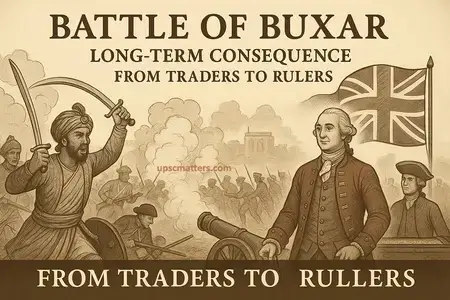
The Battle of Buxar, fought on 22 October 1764, stands as one of the most pivotal events in Indian history. It marked a significant shift in power from Indian rulers to the British East India Company. Unlike the Battle of Plassey, which was largely political, the Battle of Buxar was a military confrontation that sealed the Company’s control over Bengal and laid the foundation for British expansion across India. This article explores the short-term and long-term consequences of the Battle of Buxar, helping students and UPSC aspirants understand its profound impact on India’s political and economic future.
Background / Context of Battle of Buxar
- Decline of Siraj-ud-Daulah and Mir Jafar’s failure as Nawab after Plassey.
- Installation of Mir Qasim as Nawab by the British.
- Growing tensions between Mir Qasim and the British over trade privileges and autonomy.
Date and Location
- Date: 22nd October 1764
- Location: Buxar, on the banks of the Ganga River, in present-day Bihar.
Causes of the Battle of Buxar
- Mir Qasim’s attempt to abolish internal duties to create a level playing field.
- Mir Qasims Assertion: – Ram Narayan (supported by British.), the deputy governor of Bihar, refused to submit the accounts of Bihar’s revenues despite repeated requests from Mir Kasim. This open defiance of Mir Kasim’s authority led to tensions.
- British East India Company’s misuse of dastaks (trade permits).
- Expulsion of British from Patna and Bengal by Mir Qasim.
- Alliance of Mir Qasim with Shah Alam II (Mughal Emperor) and Shuja-ud-Daula (Nawab of Awadh).
Why Mir Qasim/Kasim Is Considered a Better Administrator than Mir Jafar ?
Administrative Reforms
- Mir Qasim tried to streamline administration and reduce corruption.
- He moved his capital from Murshidabad to Munger (Bihar) to gain independence from British interference.
- Built a modern arsenal at Munger, showing focus on military modernization.
Military Reforms by Mir Qasim
- Modernization of the Army
- Mir Qasim aimed to build a modern, disciplined army independent of British control.
- He recruited Indian soldiers and trained them in European-style warfare.
- Tried to reduce reliance on feudal levies and irregular troops.
- Appointed Armenian Instructors to train the army on modern lines.
- Arsenal at Munger
- Set up a state-of-the-art arsenal in Munger (Bihar).
- Manufactured modern weapons, ammunition, and artillery.
- Munger became his new military and administrative capital.
Revenue Reforms
- Attempted to improve the revenue system and curb revenue leakage.
- Took steps to increase state income and reduce dependence on external loans.
- Mir Qasim granted the East India Company the right to collect revenue from the districts of Burdwan, Midnapore, and Chittagong, as well as half of the Sylhet chunam trade.
- These concessions were likely motivated by Mir Qasim’s desire to maintain his position as Nawab and limit the Company’s political influence in Bengal. He hoped to create a situation where the British would be less likely to interfere in his administration and that he would be able to maintain a degree of autonomy
Trade Reforms
- Abolished internal duties (octroi/Jakat) to create a level playing field for Indian traders.
- Challenged the East India Company’s misuse of dastaks (duty-free passes) which hurt local economy.
- This reform earned him popularity among Indian merchants, but created conflict with the British.
Assertion of Sovereignty
- Unlike Mir Jafar, who acted as a British puppet, Mir Qasim asserted his independence.
- Tried to build an independent army and improve military infrastructure.
Mir Qasim is remembered not only as a better administrator but also as one of the first Indian rulers to resist British economic exploitation. His assertiveness led to his downfall, but it highlighted early efforts to safeguard Indian sovereignty.
Opposing Sides in Battle of Buxar-
British East India Company
- Commander: Hector Munro
- Strength: ~7,000 troops
Triple Alliance:
- Mir Qasim (Ex-Nawab of Bengal)
- Shuja-ud-Daula (Nawab of Awadh)
- Shah Alam II (Mughal Emperor)
- Strength: ~40,000 troops
Course of the Battle of Buxar
- The alliance lacked coordination and leadership.
- The British forces were better trained and organized.
- The allied forces were decisively defeated by the British.
Outcome of the Battle of Buxar
- British won a decisive victory.
- Established their military superiority in northern India.
- Shah Alam II surrendered and later signed the Treaty of Allahabad (1765).
Significance / Consequences (Synopsis)–
- British got the Diwani rights (revenue collection) of Bengal, Bihar, and Orissa.
- Foundation of British administrative rule in India.
- End of Mughal political authority in practice.
- Awadh became a buffer state between British territories and other Indian powers.
- Confirmed the British transition from traders to rulers.
Consequences in detail are given below-
Consequences of the Battle of Buxar (1764)
Short-Term Consequences
- Decisive British Victory- East India Company defeated the combined forces of: Mir Qasim (former Nawab of Bengal), Shuja-ud-Daula (Nawab of Awadh), Shah Alam II (Mughal Emperor).
- Treaty of Allahabad (1765)- (discussed in detail below)
- Company Became a Revenue Power
- Got fiscal control over rich provinces without formal annexation.
- Gained legal recognition from the Mughal Emperor, legitimizing their rule.
- Decline of Mir Qasim- Mir Qasim lost all support and fled.Marked the final failure of Indian military resistance in eastern India during that phase.
Long-Term Consequences
Establishment of British Political Supremacy
- Marked the real beginning of British rule in India.
- Transition from a trading company to a political power with administrative authority.
Beginning of Dual Government in Bengal (1765–1772)
- The British controlled revenue (Diwani), while the Nawab retained administration (Nizamat).
- Led to administrative chaos, corruption, and economic distress.
Mughal Empire Became Symbolic
- Shah Alam II became dependent on British support.
- Mughal emperor lost real power, marking the de facto end of the Mughal Empire.
Awadh Became a Buffer State
- Used by British as a strategic barrier between Bengal and the Marathas/Rohillas.
- Eventually led to British interference and later annexation.
Rise of British Economic Control
- Control over Bengal’s resources led to huge profits for the Company.
- Strengthened the Company’s position in Bombay and Madras Presidencies as well.
Set the Stage for Future Expansion
- Buxar gave the Company a military and financial base to expand into:Awadh, Delhi, Central and South India.
Conclusion
“If Plassey made the British masters of Bengal, Buxar made them masters of India.”
It was Buxar—not Plassey—that confirmed British dominance, both militarily and politically, making it a true turning point in Indian history.
Treaty of Allahabad after Battle of Buxar (1765)
- Two treaties were Signed between Robert Clive and Shah Alam II and Robert Clive and Shuja-ud-daula.
- Company received Diwani rights from the Mughal Emperor.
- Shah Alam II granted the Diwani rights (right to collect revenue) of: Bengal, Bihar, & Orissa
- In return, the Company agreed to pay an annual tribute of Rs. 26 lakhs to the Emperor.
- Shah Alam II was to reside at Allahabad, under British protection.
- Shuja-ud-Daula had to pay war indemnity and regain his territory under British protection.
- As part of the treaty, the Nawab of Awadh (Shuja-ud-Daulah) ceded Allahabad and Kora to the Mughal Emperor, Shah Alam II.
- Shuja-ud-daula granted full possession of the estate of Balwant Singh, Zamindar of Banaras.
Significance:
- Legitimized British rule in eastern India.
- Awadh was not annexed by Briitsher’s, but kept it as a buffer state between British and Marathas or Afghans.
- Marked the beginning of dual government in Bengal (Company controlled revenue; Nawab handled administration nominally (Nizamat rights).
- Diwani functions: For the Diwani functions, the Company appointed two Deputy Diwans
- Mohammad Reza Khan for Bengal and Raja Sitab Roy for Bihar.
- Mohammad Reza Khan also served as the deputy Nazim or deputy subahdar of Bengal.
Consequences of Dual Government in Bengal (1765–1772)
What Was Dual Government?
- Introduced by Robert Clive in 1765 after the Battle of Buxar.
- The British East India Company had Diwani rights (revenue collection).
- The Nawab retained Nizamat functions (law, order, and administration).
- In reality, British controlled everything but held no responsibility.
Consequences of Dual Government
Breakdown of Governance
- The Nawab had no resources to enforce law and order.
- The Company collected revenue but didn’t invest in administration.
- Resulted in administrative paralysis and lawlessness.
Economic Exploitation
- Company extracted maximum revenue without accountability.
- Over-taxation and pressure on peasants, zamindars, and artisans.
- Led to economic decline and rural distress.
Worsening of Famine
- During the Great Bengal Famine (1770), over 10 million people died.
- The Company did not intervene, as it had no administrative obligation.
- Revenue demands were not reduced, worsening the crisis.
Corruption and Loot
- Company officials amassed personal fortunes by exploiting the system.
- Lack of checks allowed for massive corruption and bribery.
- Bengal became a victim of “plunder without governance.”
Decline of the Nawab’s Authority
- The Nawab was reduced to a puppet, with no real power.
- Lost respect and legitimacy in the eyes of the people.
Loss of Accountability
- The Company had power but no responsibility.
- This imbalance led to misrule and systemic decay.
End of Dual Government (1772)
- Warren Hastings abolished the system in 1772.
- Took direct control of administration, starting the Company’s formal rule in Bengal.
Conclusion- The Dual Government system exposed the dangers of power without responsibility. It led to political instability, economic devastation, and humanitarian crises, highlighting the exploitative nature of early British rule in India.
If you found this helpful, you might also like these articles:
📌 [https://upscmatters.com/indus-valley-civilization/ ]
📌 [https://upscmatters.com/buddhism-a-complete-guide-for-upsc-history/]
📌[https://upscmatters.com/advent-of-europeans-in-india-arrival-expansion/]
They cover key concepts that will boost your preparation! 🚀
📢 Stay Updated with the Best UPSC Resources!
Join our Telegram Channel for:
✅ Daily Current Affairs
✅ Important Notes & PDFs
✅ Answer Writing Tips
✅ Strategy & Motivation
📲 Click the link to join now: [https://t.me/upscmatters] or [https://t.me/ramsirnotes]
Don’t miss out on valuable updates! 🚀