
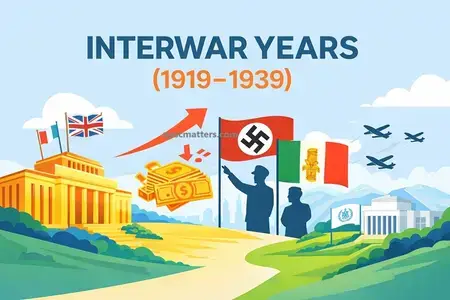
Introduction: Interwar Years (1919–1939)
The Interwar Years (1919–1939) represent one of the most unstable and decisive phases of modern world history. Instead of ensuring lasting peace, the post–World War I settlement created political, economic, and social conditions that undermined democracies and encouraged aggressive authoritarian regimes. For UPSC aspirants, the interwar period is crucial to understand the failure of peace, rise of fascism and Nazism, and the direct causes of World War II.
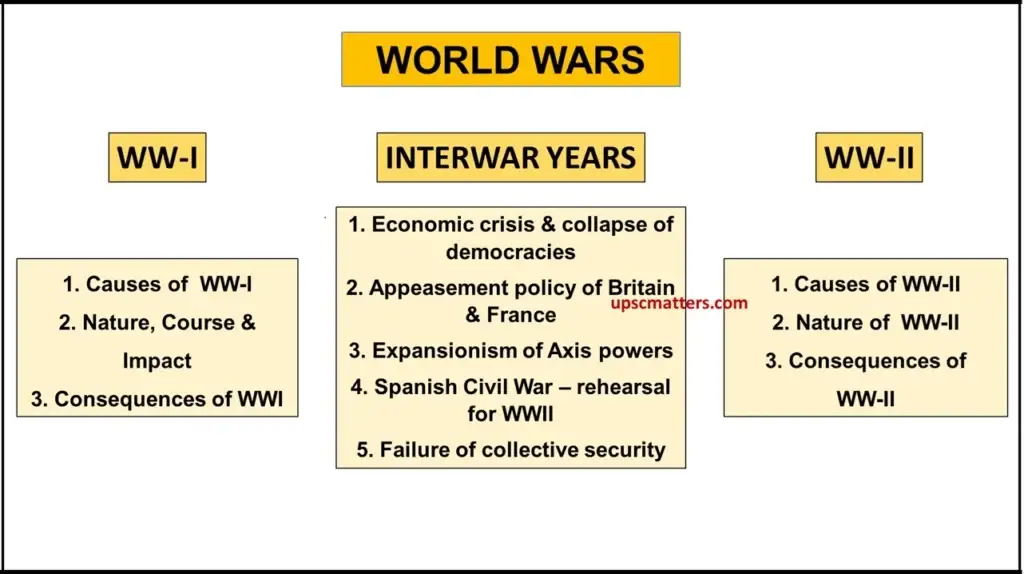
This article is the second in a three-part sequence covering the World Wars. The full series will explore World War I, the Interwar Years, and World War II; this installment focuses exclusively on the Interwar Years (1919-1939).
Before continuing, you may wish to read the first article in this series, which covers the events of World War I- for reading it, kindly Click here.
1. Economic Crisis & Collapse of Democracies
A. Post–WWI Economic Instability
- European economies were shattered after WWI.
- Huge war debts, reparations, inflation → instability.
- Germany faced hyperinflation (1923), ruining middle-class savings.
B. The Great Depression (1929)
- The U.S. stock market crash spread globally.
- World trade collapsed by almost 70%.
- Unemployment skyrocketed:
- Germany: ~6 million jobless
- Britain, France: millions unemployed
- Governments could not manage the crisis.
C. Collapse of Democracies
- Economic misery discredited democratic governments (seen as weak, indecisive).
- People turned to extremist parties promising:
- Jobs
- National pride
- Stability
- Strong leadership
- Result:
- Germany → Nazi dictatorship (1933)
- Italy → Fascism strengthened
- Japan → Military rule
- Spain → Civil war against democracy
Ques- Economic distress created fertile ground for authoritarian leaders who later dragged the world into war.
2. Appeasement Policy of Britain & France. (IMP)
A. What is appeasement during Interwar Years (1919–1939)?
- A diplomatic policy where Britain & France gave concessions to Hitler and Mussolini, hoping it would prevent another war.
B. Why they adopted appeasement
- War fatigue: Memories of WWI horrors still fresh.
- Economic weakness: Depression crippled British & French economies.
- Fear of communism: They saw Hitler as a barrier against Soviet communism.
- Guilt over Versailles Treaty: Many in Britain believed the treaty was too harsh on Germany.
- Colonial concerns: Britain & France were overstretched in their empires.
C. Key Appeasement Decisions
- German rearmament allowed (1935)
- Rhineland remilitarised (1936) – no action taken
- Anschluss with Austria (1938) – accepted
- Munich Agreement (1938)-
- Gave Sudetenland (Czechoslovakia) to Germany
- PM Chamberlain declared “peace for our time”
Effect:
- Encouraged Hitler that Allies would not resist force.
- Expanded Germany’s power without war → made war inevitable.
3. Interwar Years (1919–1939)– Expansionism of Axis Powers
Axis powers = Germany, Italy, Japan
Their aggressive expansion directly dismantled peace.
A. Germany
1) Remilitarisation of the Rhineland (1936)
- Treaty of Versailles banned troops in Rhineland.
- Hitler sent German army; Britain & France did nothing.
- Turning point → Hitler became confident Allies would not resist.
2) Annexation of Austria (Anschluss, 1938)
- Austria merged with Germany without resistance.
- Popular support in Austria + no Allied action.
3) Sudetenland & Czechoslovakia (1938–39)
- Sudetenland given to Hitler by Munich Agreement.
- In 1939, Hitler seized the rest of Czechoslovakia.
B. Italy
Italian invasion of Ethiopia (Abyssinia) – 1935
- Mussolini invaded to build a new Roman Empire.
- League of Nations imposed weak sanctions.
- Britain and France secretly tried to compromise (Hoare-Laval Pact).
→ Italy turned toward Hitler → Rome–Berlin Axis formed (1936).
C. Japan
Invasion of Manchuria (1931)
- Japan staged the Mukden Incident as pretext.
- Occupied Manchuria → created puppet state Manchukuo.
- League condemned it; Japan withdrew.
Invasion of China (1937)- Full-scale war; atrocities like Nanjing Massacre.
→ No major power intervened
Ques → Axis expansion succeeded because the international system was too weak and democratic powers were unwilling to act.
4. Interwar Years (1919–1939)–Rise of Dictatorships
A. Fascism in Italy
Economic instability, fear of communism, and political chaos enabled Mussolini to establish a fascist dictatorship promising order, nationalism, and expansion.
B. Nazism in Germany
Nazism capitalised on:
- Versailles resentment
- Economic collapse
- Weak democratic institutions
Hitler’s regime combined totalitarian control, racial ideology, and aggressive expansionism.
C. Japanese Militarism
Civilian governments were sidelined as military leaders justified imperial expansion as a solution to economic vulnerability.
UPSC Insight: Totalitarian regimes thrived by exploiting fear, insecurity, and nationalist sentiment.
5. Spanish Civil War (1936–39) – A Rehearsal for WWII
A. What happened?
- Conflict between democratically elected Republicans and the Nationalists led by General Franco.
- Civil war became internationalized:
- Germany & Italy supported Franco with troops, aircraft, weapons.
- USSR supported the Republicans.
- Western democracies stayed neutral (non-intervention policy).
B. Why it is called a rehearsal for WWII
1.Testing new weapons
1.German Luftwaffe bombed Guernica (1937) → practice for Blitzkrieg.
Blitzkrieg[a] (Lightning/Flash Warfare) is a word used to describe a combined arms surprise attack, using a rapid, overwhelming force concentration that may consist of armoured and motorized or mechanized infantry formations, together with artillery, air assault, and close air support. The intent is to break through an opponent’s lines of defence, dislocate the defenders, confuse the enemy by making it difficult to respond to the continuously changing front, and defeat them in a decisive a battle.
2.Axis cooperation- Germany & Italy coordinated military actions.
3.Ideological battlefield- Fascism vs Communism.
4.Failure of democracies
- Britain & France refused to help the Spanish Republic.
- Showed that democracies would not resist fascist aggression.
Outcome:
- Franco won; Spain became a dictatorship until 1975.
- Demonstrated a larger trend: fascism on the rise, democracies retreating.
6. Failure of League of Nations
A. What is collective security?
The League of Nations embodied the ideal of collective security but failed in practice. It meant-An attack on one is an attack on all.
B. Why it failed
1) Absence of major powers
- USA never joined
- USSR joined late
- Germany, Japan, Italy withdrew
2) No enforcement mechanism
- League had no army.
- Relied on members’ voluntary action → rarely happened.
3) Unanimous voting- Any nation could block action.
4) Weak response to aggression
- Manchuria (1931): no action against Japan.
- Ethiopia (1935): sanctions ineffective.
- Rhineland (1936): ignored.
- Czechoslovakia (1938): Allies chose appeasement.
5) Distrust among major powers
- Britain and France focused on their own security.
- USSR distrusted Western powers → signed Nazi–Soviet Pact (1939)
Ques- → Collective security collapsed completely by late 1930s, paving the way for World War II.
To read League of Nations – Successes, Failures & Structural Weaknesses– Click here
7. Treaty of Versailles and Its Destabilizing Impact
The Treaty of Versailles attempted to punish Germany rather than integrate it into a stable international order. Its key consequences included:
- Territorial losses and military restrictions
- War guilt and heavy reparations
- Political humiliation of Germany
Instead of ensuring peace, the treaty fostered resentment and revisionism. The Weimar Republic, which accepted the treaty, was branded weak and illegitimate, providing fertile ground for extremist forces.
UPSC Insight: The Treaty of Versailles created a peace settlement that was harsh enough to provoke resentment, but weak enough to be violated.
to know more about Treaty of Versailles– Click here
8. Why the Interwar Peace Failed
The interwar order collapsed because:
- Economic instability undermined political systems
- Peace treaties were unjust and unenforceable
- International institutions lacked authority
- Democracies prioritised short-term peace over long-term stability
- Aggressive powers exploited weakness and indecision
Conclusion
The interwar years demonstrate that peace settlements lacking economic stability, political inclusiveness, and effective enforcement mechanisms cannot ensure long-term security. The collapse of democracies, rise of authoritarian regimes, and failure of international institutions during this period offer critical lessons for contemporary global governance and conflict prevention.
If you found this helpful, you might also like these articles:
[https://upscmatters.com/indus-valley-civilization/ ]
[https://upscmatters.com/buddhism-a-complete-guide-for-upsc-history/]
[https://upscmatters.com/advent-of-europeans-in-india-arrival-expansion/]
They cover key concepts that will boost your preparation!
Stay Updated with the Best UPSC Resources!
Join our Telegram Channel for:
Daily Current Affairs
Important Notes & PDFs
Answer Writing Tips
Strategy & Motivation
Click the link to join now: [https://t.me/upscmatters] or [https://t.me/ramsirnotes]
Don’t miss out on valuable updates!