
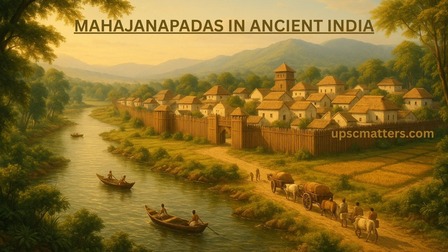
Mahajanapadas in Ancient India:- By the 6th century BCE, India witnessed a major transformation in its political, economic, and social landscape. Small tribal settlements of the Vedic age gradually evolved into larger territorial units known as Mahajanapadas. Spread across the Indo-Gangetic plains and north-western regions, these sixteen states laid the foundation of organised governance, urbanisation, and imperial expansion in ancient India.
Timeline of Mahajanapadas (600–321 BCE)
- c. 600 BCE → Emergence of 16 Mahajanapadas (Anguttara Nikaya & Bhagavati Sutra list them).
- c. 543–492 BCE → Bimbisara (Magadha) expands territory, annexes Anga.
- c. 492–460 BCE → Ajatashatru defeats Kosala & Vajji; builds fort at Pataligrama (later Pataliputra).
- c. 460–413 BCE → Period of conflicts: Magadha vs Avanti, Kosala, Vatsa.
- c. 413 BCE → Shishunaga dynasty absorbs Avanti, ending rivalry.
- c. 345 BCE → Mahapadma Nanda rises, called Ekarat (“sole sovereign”), expands Magadha into a pan-Indian power.
- 321 BCE → Chandragupta Maurya overthrows Nanda rule, founding the Mauryan Empire.
Background and Emergence of Mahajanapadas
1. Timeframe
- Period: Around 6th century BCE, also called the Age of Second Urbanisation.
- Transition phase from Later Vedic tribal polity → territorial states (janapadas → mahājanapadas).
- This is the prelude to large empires like Magadha and Maurya.
2. Causes of Rise
(a) Iron Technology & Agricultural Expansion
- Use of iron ploughshare → more effective agriculture, especially in the fertile alluvial soil of the Ganga valley.
- Resulted in surplus production → supported larger populations, towns, armies, and state systems.
- Example: Eastern UP & Bihar (future Magadha) benefited the most due to iron ore deposits in Chotanagpur plateau.
Prelims angle: “Iron ploughshare” is directly linked with the second urbanisation & emergence of states.
(b) Growth of Trade & Towns (Second Urbanisation)
- With food surplus, specialisation of crafts & trade grew.
- Urban centres like Rajagriha, Shravasti, Ujjain, Kausambi, Taxila emerged.
- First punch-marked coins (karshapanas) introduced → facilitated trade.
- Development of guilds (shrenis) → organised economic units.
- Trade routes (like Uttarapatha & Dakshinapatha) linked these centres → enhanced interregional interaction.
This marks the Second Urbanisation in India (the first being Harappan).
(c) Social Changes (Varna → Jati)
- Varna system from Vedic age started fragmenting into jatis (sub-castes) due to:
- Craft specialisation (weavers, smiths, merchants forming their own groups).
- Urbanisation → new occupations.
- Shudras got more role in productive economy, though lower status remained.
- Emergence of new religious ideas (Buddhism, Jainism) that questioned rigid varna order.
This social churning created conditions for different forms of polity (republics vs monarchies).
(d) Rise of Gana-Sanghas & Monarchies
- From tribal units (jana) → territorial units (janapadas).
- Some evolved into monarchies (Magadha, Kosala, Avanti, Vatsa).
- Others evolved into gana-sanghas (oligarchic republics) like Vajji (Lichchhavis), Malla, Shakyas.
- These states needed strong political organisation to manage population, surplus, and trade → hence consolidated into larger Mahājanapadas.
Contrast: Monarchies expanded aggressively, while gana-sanghas remained limited and eventually absorbed.
Essence (for Mains-style analysis)
The emergence of Mahājanapadas was not a sudden event. It was the combined outcome of:
- Technological progress (iron)
- Economic transformation (urbanisation, trade, coinage)
- Social restructuring (varna → jati, rise of heterodox ideas)
- Political consolidation (tribes → states)
Together, they laid the foundation of Magadhan imperialism and the later Mauryan Empire.
List of the 16 Mahajanapadas in Ancient India
| Mahājanapada | Capital | Present-day location (approx.) |
| Anga | Champa | Bhagalpur & Munger (Bihar) |
| Magadha | Rajagriha (later Pataliputra) | Southern Bihar (Patna, Gaya, Nalanda) |
| Vajji | Vaishali | North Bihar (Vaishali district) |
| Malla | Kusinara & Pava | Eastern Uttar Pradesh (Gorakhpur, Deoria, Kushinagar) |
| Kashi | Varanasi | Eastern Uttar Pradesh (Varanasi region) |
| Kosala | Shravasti (later Ayodhya also important) | Eastern UP (Faizabad, Gonda, Bahraich) |
| Vatsa | Kausambi | Near Allahabad/Prayagraj (UP) |
| Avanti | Ujjain & Mahishmati | Western Madhya Pradesh (Malwa region) |
| Chedi | Shuktimati | Bundelkhand (MP & UP) |
| Kuru | Indraprastha (Delhi), Hastinapur | Delhi–Meerut region (Haryana–Western UP) |
| Panchala | Ahichchatra (North), Kampilya (South) | Western UP (Bareilly, Badaun, Farrukhabad) |
| Matsya | Viratanagara (modern Jaipur/Alwar) | Rajasthan (Jaipur–Alwar region) |
| Gandhara | Taxila | North-west Pakistan (Rawalpindi/Taxila) |
| Kamboja | Rajapura (uncertain) | Kashmir & north-east Afghanistan |
| Asmaka (Ashmaka) | Potali | Between Narmada & Godavari (Maharashtra–Telangana border, modern Nizamabad) |
| Surasena | Mathura | Western Uttar Pradesh (Mathura region) |
Classification of Mahajanapadas: Monarchies vs Republics
1. Monarchies (Rājya / Samrājya type)
- Majority of Mahājanapadas were monarchies.
- Headed by hereditary kings (Raja, Maharaja).
- Power legitimised through rituals (e.g., Vedic sacrifices, Ashvamedha).
- Supported by a council (parishad) but real power lay with the king.
- Standing armies & revenue systems (taxes on agriculture, trade, artisans).
- Examples:
- Magadha (Bimbisara, Ajatashatru)
- Kosala (Prasenajit)
- Vatsa (Udayana)
- Avanti (Pradyota dynasty)
These monarchies expanded territorially and ultimately paved the way for the Magadhan Empire.
2. Republics (Gana-sanghas / Oligarchic republics)
- Found mostly in the foothills of Himalayas, NW India, and eastern UP/Bihar.
- Headed not by a king but by a collective assembly of chiefs (Kshatriyas).
- Decision-making was through sabhas or councils (Santhagara = assembly hall).
- Each clan/family had a vote; decisions taken collectively (hence “gana” = group, “sangha” = assembly).
- Leadership often rotated or was shared among aristocratic families.
- Examples:
- Vajji (Lichchhavis) – strong confederacy, famous for their council system.
- Malla – with centres at Kusinara & Pava.
- Shakyas – clan of Gautama Buddha (capital: Kapilavastu).
- Kamboja – in NW frontier, often linked with horse trade.
3. Features of Gana-sanghas (Republics)
- Collective decision-making → ruled by an oligarchy (mostly Kshatriyas).
- Assemblies (Santhagara) → debates, votes, consensus-based decisions.
- No hereditary monarchy → instead, a set of ruling lineages/clans.
- Military participation: every ruling family had to contribute soldiers.
- Limited democracy? → not democratic in modern sense, but showed early republican traditions.
- Famous Buddhist text Mahāparinibbāna Sutta praises the Vajjians for their orderly conduct and frequent assemblies.
| Aspect | Monarchies | Republics (Gana-sanghas) |
| Political head | Hereditary king | Collective assembly of clan chiefs |
| Decision-making | King with ministers | Sabha/Santhagara, collective voting |
| Expansion | Militarily aggressive, annexed neighbours | Defensive, confederacies formed |
| Stability | More stable, long-term dynasties | Short-lived, fragmented |
| Examples | Magadha, Kosala, Avanti, Vatsa | Vajji, Malla, Shakya, Kamboja |
UPSC Mains Angle
- Republics show that India had oligarchic/collective polities much before the Greeks (contrast with Athens).
- But due to small size, lack of centralised military power, and fragmentation, republics could not compete with large monarchies.
- Their absorption by Magadha shows the transition from clan-based rule → imperial monarchies.
Vajji Confederacy (c. 6th century BCE)
1. Background
- One of the 16 Mahājanapadas.
- Located in north Bihar, with Vaishali as its capital.
- Known as the Vajji Mahājanapada (sometimes called Videha-Vajji).
- Mentioned in Buddhist texts (e.g., Mahāparinibbāna Sutta), Jain texts (Bhagavati Sutra).
2. Constituents
- A confederacy of clans, mainly:
- Lichchhavis (most powerful)
- Videhas
- Jnatrikas (Mahavira’s clan)
- Others
- Total: 8 or 9 clans, bound by mutual alliance.
3. Polity & Governance
- Republican (gana-sangha) system.
- General Assembly (Santhagara):
- Representatives from different clans.
- Met frequently to decide matters of administration, justice, and war.
- Collective leadership – no hereditary monarch.
- Decisions often taken by consensus; voting used when necessary.
- Highly participatory among aristocratic families, though common people had little role.
4. Strengths
- Well-organised polity, admired in Buddhist texts.
- Mahāparinibbāna Sutta mentions 7 qualities that gave strength to the Vajjians (unity, regular assemblies, respect for elders, protection of women, respect for shrines, etc.).
- Had strong fortifications (Vaishali), and well-developed agriculture and trade.
5. Weakness & Decline
- Internal divisions among clans → weakened unity.
- Could not match the centralised, militarily strong monarchy of Magadha.
- Eventually defeated and absorbed by Ajatashatru of Magadha (through war and diplomacy, including use of a war engine rathamusala).
6. Significance
- Shows existence of republican traditions in ancient India.
- Links to Jainism (Mahavira born in Jnatrika clan, part of Vajji) and Buddhism (Buddha praised Vajjians).
- Represents collective governance, in contrast to monarchies → early experiment in oligarchic republics.
UPSC Mains Insight:
- “Discuss the significance of gana-sanghas like Vajji in the evolution of Indian polity.”
- “Why did monarchies ultimately prevail over republics in the 6th century BCE?”
Political & Administrative Features of Mahajanapadas
1. Nature of Kingship
- Monarchies:
- King (Rājā / Mahārājā) was hereditary, often from the Kshatriya clan.
- Seen as protector of dharma and people.
- Legitimacy reinforced through Vedic sacrifices (e.g., Ashvamedha, Rajasuya, Vajapeya).
- Maintained standing armies, unlike earlier tribal militias.
- Expansionist in outlook → frequent wars for territory (Magadha vs Kosala, Avanti, Vatsa).
- Republics (Gana-sanghas):
- No hereditary king.
- Collective leadership by assemblies of clan chiefs.
- Rotational headship sometimes practiced (Raja/Mahāsāmanta chosen for limited terms).
- Strong military ethos → every ruling family contributed warriors.
Takeaway: Both systems show a shift from tribal lineage authority → territorial, institutionalised state systems.
2. Assemblies & Councils
- Monarchies:
- Sabha → advisory council of elders/nobles.
- Parishad → smaller, select group of ministers/priests advising the king.
- Though advisory, kings often dominated.
- Republics (Gana-sanghas):
- Santhagara (assembly hall) → central institution, where representatives met.
- Functioned as a council of ruling clans (aristocratic republic, not mass democracy).
- Debates and discussions common; sometimes voting done.
- Buddhist texts (Mahāparinibbāna Sutta) praise the Vajjians for frequent assemblies, respect for elders, and consensual governance.
Assemblies reflect participatory elements in early Indian polity.
3. Revenue System
To sustain armies, forts, and administration, states developed regular taxation:
- Agricultural tax (Bhāga): Usually 1/6th of produce taken by state.
- Bali: Traditional Vedic offering to king/state (later became regular tax).
- Kara: Tribute from conquered territories or vassals.
- Customs & Trade duties: On caravans, market goods, traders.
- Forced labour (Vishthi): Subjects sometimes obliged to provide unpaid labour for state works.
- Guild taxes: Craft guilds (shrenis) paid taxes in cash/kind.
- Cattle tax & war booty: Especially in early phase.
This reflects the transition from a chiefdom economy to an institutionalised revenue-based state.
4. Law & Order / Administration
- Maintenance of fortified capitals (nagara) → symbol of power and security.
- Standing armies with infantry, cavalry, elephants, and chariots.
- Early judicial functions rested with king or assembly.
- Espionage and diplomacy mentioned in later texts (esp. Magadha under Ajatashatru).
Essence for UPSC Mains
- The Mahājanapadas mark the first phase of organised states in India.
- Kingship became hereditary and ritualised in monarchies, while republics experimented with collective rule.
- Emergence of taxation, fortified towns, assemblies, and professional armies show the transition to a state system, setting the stage for Magadhan imperialism and Mauryan centralisation.
Revenue System of Mahajanapadas in Ancient India
1. Background
- With emergence of large territorial states, a regular revenue system became necessary.
- Earlier tribal contributions (bali, voluntary gifts) → evolved into compulsory taxation.
- Taxes funded:
- Standing armies
- Fortifications & administration
- Religious/ritual expenses of rulers
2. Types of Taxes & Dues
| Tax / Levy | Meaning & Nature | Notes |
| Bhāga | Share of produce (usually 1/6th of harvest) | Core land revenue; mostly in kind |
| Bali | Originally voluntary offering → became compulsory tax | Collected in cash/kind |
| Kara | Tribute paid by conquered/vassal states | Political + economic control |
| Shulka / Sulka | Customs, tolls on trade & movement of goods | Important in urban centres & along trade routes |
| Hiranya | Cash payments (often substitute for kind taxes) | Indicates monetisation of economy |
| Vishthi | Forced labour, unpaid service by peasants/artisans | Used for public works, army needs |
| Cattle tax & War booty | On pastoralists; booty from conquests also significant | More common in early phase |
3. Collection System
- Local officials and village headmen collected dues.
- Guilds (shrenis) also paid taxes collectively.
- Surplus often stored in fortified towns (capitals).
- Sometimes maintained in granaries for army supply.
4. Significance
- Revenue from agriculture + trade gave monarchies like Magadha a decisive edge.
- Control of fertile Ganga plains → stable surplus → large standing armies.
- Republics relied more on clan contributions → less sustainable in long run.
5. Magadha’s Rise & Revenue
- Magadha benefited from:
- Fertile rice-growing plains of Bihar.
- Iron ore deposits (for tools & weapons).
- Tax from trade along Ganga.
- Strong fiscal base allowed Bimbisara & Ajatashatru to maintain huge armies & fortifications.
Quick UPSC Angle
- Prelims may ask: “Bhāga in ancient India referred to — ?” (Ans: Share of agricultural produce as tax).
- Mains may ask: “Examine the role of agriculture and taxation in the rise of Magadha.”
Economic Life of the Mahajanapadas in Ancient India
1. Agricultural Expansion with Iron Technology
- Iron ploughshare widely used → enabled cultivation of hard alluvial soil in the Ganga valley.
- Expansion of rice cultivation → higher yield & surplus.
- Use of irrigation (wells, canals, tanks) in some areas.
- Led to settled agriculture → supported dense population & urban growth.
- Magadha’s edge: fertile soil + abundant rainfall + nearby iron ore deposits.
UPSC Prelims angle: “Use of iron ploughshare” is directly linked with Second Urbanisation.
2. Trade & Towns – Second Urbanisation
- After Harappans, new wave of urbanisation began (~600 BCE) = “Second Urbanisation”.
- Towns (nagara / nigama) emerged:
- Rajagriha, Vaishali, Kausambi, Ujjain, Shravasti, Mathura, Taxila.
- Located along trade routes (e.g., Uttarapatha in north & Dakshinapatha in south).
- Rise of professional merchants (setthis) and bankers.
- Existence of urban markets (hatta, mandis) recorded in Pali texts.
Significance: Towns acted as hubs for administration, trade, religion (Buddhism & Jainism flourished in urban centres).
3. Punch-Marked Coins (First Coins in India)
- Earliest coins in India, c. 6th century BCE.
- Made of silver (mainly), some copper.
- Not inscribed with rulers’ names; instead had symbols punched (sun, trees, animals, hills).
- Called Karshapanas or Panas in texts.
- Issued by merchant guilds & states → facilitated larger trade, markets, and taxation.
- Indicate monetisation of the economy.
UPSC Prelims angle: Punch-marked coins = earliest Indian coinage, different from Indo-Greek inscribed coins (later).
4. Guilds (Śreṇis)
- Organisations of artisans, merchants, and craftsmen.
- Each guild specialised in one profession: weavers, potters, smiths, traders.
- Functioned as:
- Economic units (regulated quality, wages, prices).
- Social units (acted like jatis).
- Political units (could donate to kings, temples, religious causes).
- Guilds had collective funds → also acted like early banks.
- Helped in self-regulation of economy and reduced dependence on state control.
Significance of Economic Life
- Agricultural surplus → fed towns and armies.
- Urbanisation → gave rise to political centres and spread of Buddhism/Jainism.
- Coins & guilds → showed monetisation & sophistication of economy.
- Together, they provided the material basis for state formation and Magadhan imperial expansion.
Social & Religious Developments in the Mahājanapada Age
1. Varna Hierarchy Consolidation
- Rigvedic fluidity → Later rigidity
- In early Vedic times, varna was relatively flexible.
- By 6th century BCE, varna divisions became rigid and hereditary.
- Kshatriyas vs Brahmanas
- Political power (Kshatriyas) and ritual authority (Brahmanas) often conflicted.
- Many Kshatriyas supported heterodox religions (Buddhism, Jainism) that questioned Brahmanical dominance.
- Vaishyas
- Gained prominence due to urbanisation, trade, and guild activities.
- Became important patrons of Buddhism & Jainism (e.g., merchant Anathapindika supported Buddha).
- Shudras & women
- Socially marginalised.
- Many heterodox sects promised them greater dignity and participation, which drew their support.
Essence: Social tensions from rigid varna-jati order → fertile ground for new religious movements.
2. Rise of Heterodox Religions
Emergence of Sramana traditions (non-Vedic, ascetic movements) challenging Brahmanical ritualism.
- Buddhism (founded by Gautama Buddha, 6th century BCE)
- Rejected Vedic sacrifices, rituals, and caste rigidity.
- Emphasised Four Noble Truths, Eightfold Path, Ahimsa.
- Supported by townsfolk, traders, artisans, and some rulers (Bimbisara, later Ashoka).
- Spread rapidly through urban centres of Mahājanapadas (Rajagriha, Sravasti, Vaishali, Kausambi, Ujjain, Taxila).
- for more understanding of Buddhism you can read– https://upscmatters.com/buddhism-a-complete-guide-for-upsc-history/
- Jainism (revived by Mahavira, 24th Tirthankara, 6th century BCE)
- Stressed strict ahimsa, aparigraha (non-possession), satya (truth).
- Opposed caste barriers and ritual sacrifices.
- Spread widely in Magadha, Videha, Avanti, supported by merchants and agriculturists.
- for better understanding about Jainism you can read-https://upscmatters.com/jainism-for-upsc-complete-notes-on-it/
- Ajivikas (Makkhali Gosala)
- Believed in Niyati (determinism/fate).
- Popular for some time in Magadha; patronised by Mauryan emperor Bindusara.
- Gradually declined but left a mark on ascetic traditions.
3. Interaction of Mahajanapadas with These Movements
- Urban centres → provided audiences & patrons (traders, artisans).
- Rulers:
- Bimbisara (Magadha) → patronised both Buddha & Mahavira.
- Prasenajit (Kosala) → supported Buddha.
- Udayana (Vatsa) → associated with Buddhism.
- Republics (Shakyas, Lichchhavis, Mallas) → many were directly linked to Buddha & Mahavira:
- Buddha born in Shakya clan (Kapilavastu).
- Mahavira born in Jnatrika clan (part of Vajji confederacy).
- Religious centres:
- Rajagriha (Magadha) → First Buddhist Council.
- Vaishali (Vajji) → stronghold of both Buddhism & Jainism.
- Sravasti (Kosala), Kausambi (Vatsa), Ujjain (Avanti) → became hubs of Buddhist monasteries.
Impact: These movements flourished because of the socio-economic conditions of Mahājanapadas (urbanisation, trade, discontent with varna system).
UPSC Mains Angle
- Why did Buddhism & Jainism rise in 6th century BCE?
→ Answer lies in:- Rigidity of varna order
- Expansion of towns & merchant class
- Opposition to Brahmanical rituals
- Political patronage from Mahājanapadas
- Significance: These movements reshaped Indian society, promoted ethics & morality over ritualism, and laid foundations for a more universal religious outlook.
Magadha’s Ascendancy (6th–4th century BCE)
1. Geographical & Natural Advantages
- Fertile Land of the Middle Ganga Basin
- Rich alluvial soil → supported surplus agriculture (especially rice).
- Could sustain a large population & standing army.
- Iron Ore Resources (Chotanagpur Plateau, Jharkhand)
- Abundant iron deposits nearby.
- Supplied tools (ploughs, axes) and weapons → both agricultural growth & military strength.
- Strategic Location
- Located at the confluence of Ganga, Son, Gandak, and Champa rivers.
- Rivers provided natural defence, fertile valleys, and cheap transport routes.
- Controlled major north-south & east-west trade routes.
- Elephants
- Forests of Magadha (esp. near Rajgir) provided war elephants → crucial in battles (Ajatashatru’s time).
2. Political & Military Strength
- Capital Cities
- Rajagriha (Girivraja): naturally fortified by hills.
- Later shifted to Pataliputra (modern Patna): at river confluence, strategic for trade & defence.
- Strong Rulers
- Bimbisara (c. 543–492 BCE)
- Founder of Magadhan power.
- Annexed Anga (Champa).
- Used matrimonial alliances (married princesses of Kosala, Lichchhavis, Madra).
- Built diplomatic relations and strengthened the kingdom.
- Ajatashatru (492–460 BCE)
- Defeated Vajji Confederacy (using both war & diplomacy).
- Expanded Magadha by conquering Kosala and Kashi.
- Built fort at Pataligrama → later Pataliputra.
- Used war engines like rathamusala (chariot with scythes).
- Shishunaga Dynasty (c. 413 BCE)
- Shifted capital to Vaishali, later back to Pataliputra.
- Annexed Avanti, ending rivalry.
- Mahapadma Nanda (c. 345–321 BCE)
- Called “Ekarat” (sole sovereign).
- Expanded Magadha into a pan-Indian power.
- Huge army (per Greek sources: 200,000 infantry, 20,000 cavalry, 2,000 chariots, 3,000 elephants).
- Ended rule of small republics & monarchies.
- Bimbisara (c. 543–492 BCE)
By the time of the Nandas, Magadha controlled almost all of northern India.
3. Economic Advantages
- Agricultural surplus from fertile Ganga plains.
- Trade routes (Uttarapatha & Dakshinapatha) passed through Magadha → customs & tolls enriched treasury.
- Early use of punch-marked coins facilitated monetisation.
- Tribute from conquered states added to wealth.
4. Decline of Rivals
- Kosala weakened after losing Kashi to Magadha.
- Vatsa & Avanti fell to Magadhan expansion.
- Republics (Vajji, Malla, Shakya) lacked centralised power & military strength → absorbed.
Why Magadha Succeeded (Analysis for Mains)
- Favourable geography (fertile plains + minerals + rivers).
- Superior military resources (elephants, iron weapons, war engines).
- Efficient administration & taxation (bhaga, bali, customs).
- Political acumen of rulers (alliances + aggression).
- Absorption of rivals → unified north India under one centre.
Hence, Magadha’s rise was not accidental but the outcome of geography + economy + leadership + military organisation.
Quick Memory Hack for Revision
Magadha’s rise = 4 pillars:
Fertile soil → surplus food
Iron ores → tools & weapons
Rivers → defence & trade
Strong rulers → expansion & empire
Sources for Mahajanapadas in Ancient India
1. Buddhist Texts
- Anguttara Nikaya → Lists the 16 Mahājanapadas.
- Mahāparinibbāna Sutta → Mentions Vajji Confederacy, praises their governance (regular assemblies, respect for elders, unity).
- Jatakas → Provide info on trade, towns, social life.
2. Jain Texts
- Bhagavati Sutra → Describes geography, cities, rulers of Mahājanapadas; mentions 16 Mahājanapadas too.
- Life of Mahavira linked with Vajji, Magadha, Kosala.
3. Archaeological Sources
- Punch-marked coins (Karshapanas) → first Indian coins, indicate trade & monetisation.
- Urban centres (Rajagriha, Vaishali, Ujjain, Taxila, Kausambi) → show second urbanisation.
- Fortifications & settlements → excavations at Rajgir, Vaishali.
- Inscriptions (later, from Mauryan period) → confirm rise of Magadha, but indirectly useful for earlier phase.
| Source | What it Tells Us |
| Buddhist – Anguttara Nikaya | Lists the 16 Mahājanapadas. |
| Buddhist – Mahāparinibbāna Sutta | Details on Vajji Confederacy; praises unity, assemblies, respect for traditions. |
| Buddhist – Jataka tales | Everyday life, trade routes, urban centres, social classes. |
| Jain – Bhagavati Sutra | Mentions 16 Mahājanapadas, rulers, and geography; linked with Mahavira’s journeys. |
| Archaeology – Punch-marked coins (Karshapanas) | Evidence of monetisation & trade during 6th century BCE. |
| Archaeology – Urban centres (Rajagriha, Vaishali, Ujjain, Taxila, Kausambi) | Proof of Second Urbanisation, fortified cities, craft production. |
| Archaeology – Excavations (Rajgir, Vaishali) | Fortifications, material culture of early states. |
| Inscriptions (later, Mauryan) | Indirect confirmation of Magadha’s expansion and absorption of other Mahājanapadas. |
If you found this helpful, you might also like these articles:
[https://upscmatters.com/indus-valley-civilization/ ]
[https://upscmatters.com/buddhism-a-complete-guide-for-upsc-history/]
[https://upscmatters.com/advent-of-europeans-in-india-arrival-expansion/]
They cover key concepts that will boost your preparation!
Stay Updated with the Best UPSC Resources!
Join our Telegram Channel for:
Daily Current Affairs
Important Notes & PDFs
Answer Writing Tips
Strategy & Motivation
Click the link to join now: [https://t.me/upscmatters] or [https://t.me/ramsirnotes]
Don’t miss out on valuable updates!