
Introduction to the Post-Mauryan Era
The Post-Mauryan era refers to the period after the fall of the Mauryan Empire (c. 185 BCE), characterized by political fragmentation, emergence of regional powers, increased foreign influence, and cultural synthesis. It acted as a transitional phase between the Mauryan centralized empire and the classical age of the Guptas.
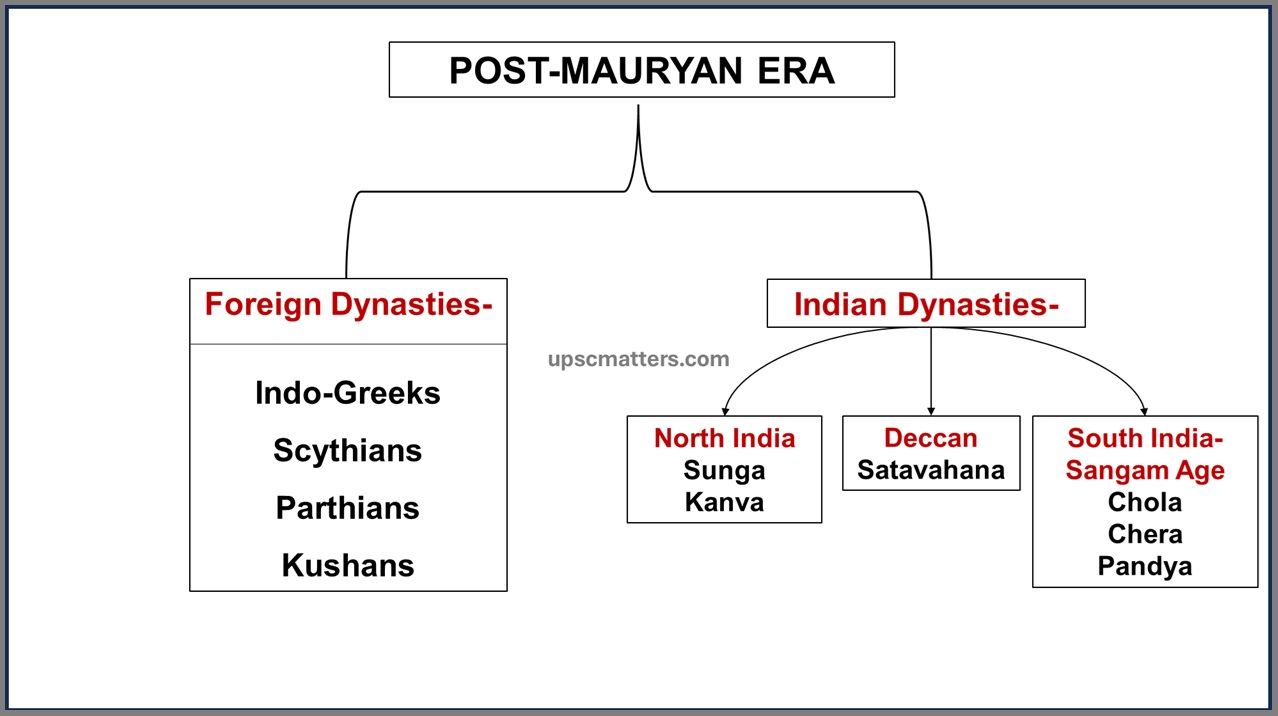
Political Developments in the Post-Mauryan Era
- Shungas and Kanvas: Successors of Mauryas in Magadha.
- Indo-Greeks: Menander (Milinda), Heliodorus pillar.
- Shakas (Scythians): Nahapana, Rudradaman I (Junagadh inscription).
- Parthians: Gondophernes (linked to Saint Thomas tradition).
- Kushanas: Kujula Kadphises, Kanishka (Saka Era, 78 CE, 4th Buddhist Council).
Key Characteristics of Post-Mauryan Era
1. Political Fragmentation and Regional Kingdoms
- Decline of Mauryan central authority led to rise of regional powers:
- Shungas (North India)
- Kanvas (Magadha)
- Satavahanas (Deccan)
- Kushanas (North-West India)
- Indo-Greeks, Shakas, Parthians (North-Western frontier)
- Chedis/Kalingas, Cheras, Cholas, Pandyas (South India)
2. Foreign Invasions and Cultural Interactions
- Indo-Greeks, Shakas, Parthians, and Kushanas entered India from the northwest.
- Introduced Hellenistic and Central Asian influences in art, coinage, dress, and administration.
- Promoted cultural and religious syncretism (e.g., Indo-Greek King Menander’s conversion to Buddhism).
3. Flourishing Trade and Commerce
- Expansion of inland and maritime trade:
- Trade with Rome, Southeast Asia, and Central Asia.
- Establishment of Silk Route and spice trade.
- Urban centers like Pataliputra, Ujjain, Taxila, Amaravati, and Bharuch became major trade hubs.
- Emergence of guilds (shrenis) and punch-marked coins as economic markers.
4. Religious Developments
- Revival of Hinduism in some areas (e.g., Bhagavatism under the Guptas later).
- Buddhism and Jainism continued to grow:
- Rise of Mahayana Buddhism under Kushanas.
- Patronage of Buddhist monasteries by rulers and traders.
- Religious art flourished under state and private patronage.
5. Art and Architecture during Post Mauryan Era
- Rise of Gandhara School of Art (Greco-Roman influence).
- Mathura School of Art: Indigenous style focusing on Hindu, Jain, and Buddhist imagery.
- Development of stupas, chaityas, and viharas: e.g., Sanchi Stupa, Amaravati.
- First anthropomorphic images of Buddha emerged during this era.
6. Literature and Language
- Sanskrit, Prakrit, and Pali continued to be literary and administrative languages.
- Religious texts, dramas, and poetry evolved.
- Spread of Buddhist texts and Jataka tales.
- Early inscriptions in Brahmi and Kharosthi scripts (e.g., Bilingual inscriptions by Indo-Greeks).
7. Coinage and Economy
- Introduction of die-struck coins by Indo-Greeks.
- Gold coins introduced by Kushanas (especially Kanishka).
- Coins depict rulers with deities, showing cultural synthesis.
8. Science and Technology
- Advancements in medicine, astronomy, and metallurgy.
- Growth of centers of learning like Taxila and Nalanda (early stages).
- Increased interaction with foreign scholars and traders facilitated exchange of knowledge.
Conclusion:
The Post-Mauryan era was a dynamic period of transition that laid the groundwork for India’s classical age. Despite political instability, the era witnessed intense cultural, economic, and religious development, making it significant for understanding early Indian civilization.
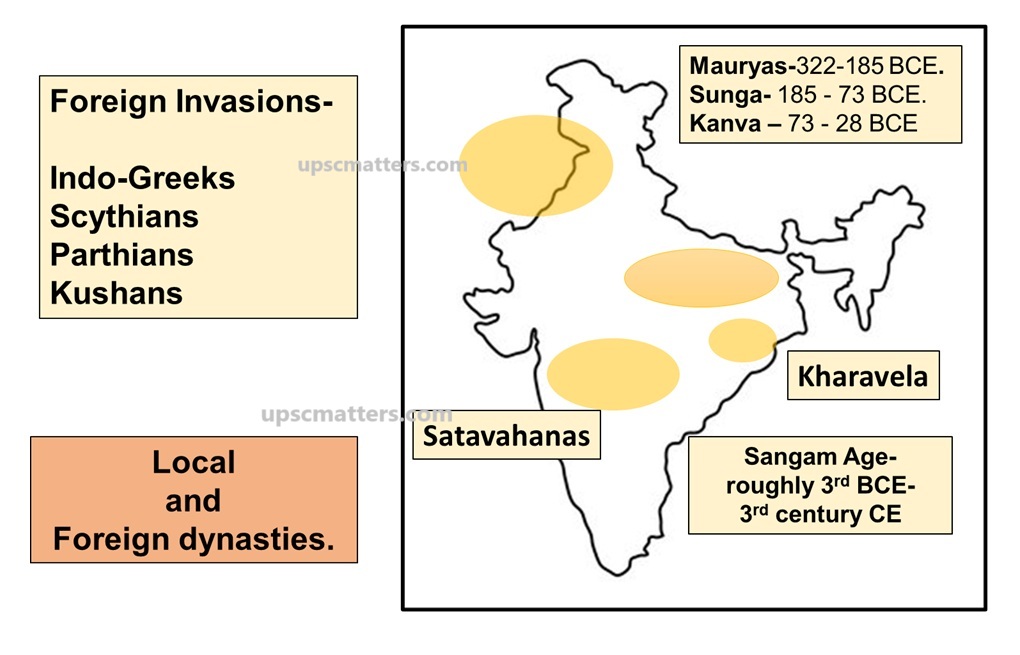
Shunga Dynasty
| Period: 185 BC – 73 BC | Capital: Pataliputra and Vidisha |
| – It was founded by Pushyamitra Shunga by assassinating the last Mauryan ruler, Brihadratha. -They ruled over northwestern and central India and up to the Narmada in the south. -They protected the Gangetic Valley from incursions from outside forces. – | |
Pushyamitra Shunga (185 – 149 BCE)
- He led a campaign against Kalinga king Kharavela.
- He ran a number of campaigns against the Indo-Greeks known as Yavanas, who were attempting to invade northwest India from Bactria during this time.
- He performed Ashvamedha to legitimise his right to rule. Dhandeva’s Ayodhya Inscription mentions him performing two Ashwamedha Yagyas.
- Although he was an ardent adherent to orthodox Hinduism, he renovated the Buddhist Stupa in Bharhut.
- Contemporary to Patanjali (author of Mahabhasya)
- His history was recorded in Banabhatta’s Harshacharita. Also mentioned in Brihadranayaka Upanishad, Ashtadhyayi, Malvikaagnimitran and Divyavandana.
Agnimitra (149 – 141 BC)
“Malvikagnimitra”, a Sanskrit drama written by Kalidasa, is related to him and is based on the love between Vidharbha princess Malvika and Sunga king Agnimitra.
Other Rulers
- Vasumitra, Vajramitra, Bhagabhadra, Devabhuti (Last ruler).
- Devabhuti, the last ruler of the Shunga dynasty, was assassinated by his minister Vasudeva Kanva, thus ending the Shunga empire.
Contribution of Shungas to Art, Architecture and Literature
Bharhut Stupa (place)
- Discovered by Cunninghum.
- Originally built by Ashoka but enlarged and renovated during the Shunga period in the mid-2nd century BC.
- Situated in Satna district of Madhya Pradesh.
- It is important for its sculptures. Red stone was used to make the railings.
- It represents the beginning of a Buddhist narrative relief and decoration tradition for holy structures. E.g. Queen Mayadevi’s dream and depiction of Ruru Jataka. (The Ruru Jataka is a Buddhist birth story (Jataka tale) about the Buddha in a previous life as a golden deer)
Sanchi Stupa (Vidisha, Madhya Pradesh)
- Discovered by General Taylor.
- Originally built by Ashoka but enlarged and renovated during the Shunga period (2nd century BC).
- Situated in the trading route of Dakshinapatha.
- Known for the lavish carvings on its decorated gateways /torans built during Satavahanas.
- Figurines in Sanchi, though small, are very naturalistic.
- Jataka stories are an important part of the narratives.
Heliodorus Pillar (near Vidisha, Madhya Pradesh)
- Stone column erected by Heliodorus, the Greek ambassador to the court of the Shunga king Bhagabhadra, around 150BC
- Erected in honour of the god Vasudeva.
- The inscription on the Pillar became famous as the Besnagar Inscription.
- It reveals that the Shungas continued the Maurya tradition of entertaining ambassadors from the Greek court.
Kanvas Dynasty (c. 73 BCE – 28 BCE)
Origin
- The Kanvas succeeded the Shungas in Magadha.
- Founded by Vasudeva Kanva, a minister of the last Shunga king Devabhuti.
- Originated as Brahmana ministers who usurped the throne, similar to how the Shungas had replaced the Mauryas.
Key Rulers
- Vasudeva Kanva (c. 73–64 BCE)
- Founder of the dynasty.
- Overthrew the last Shunga king.
- Bhumimitra (c. 64–44 BCE)
- Successor of Vasudeva.
- Mentioned in coins and inscriptions.
- Narayana (c. 44–28 BCE)
- Continued Kanva rule in Magadha.
- Susarman (last ruler, c. 28 BCE)
- Defeated by the Satavahanas, ending the Kanva dynasty.
Personalities and Records
- Very little literary material is available about them.
- Puranas are the main source mentioning Kanva kings.
- Numismatic evidence (coins) confirm their rule.
Impact and Significance
- Political:
- Ruled for only about 45 years, confined mostly to Magadha and surrounding areas.
- Could not expand like Mauryas or even Shungas.
- Cultural/Religious:
- Being Brahmanas, they likely upheld orthodox Brahmanical traditions.
- Continued the patronage of Hinduism and Sanskrit learning.
- Downfall:
- Defeated by the Satavahanas, who gained control over Magadha.
- Marked the end of Brahmana dynasties in Magadha (Maurya → Shunga → Kanva).
Conclusion
The Kanvas were a short-lived dynasty that continued the legacy of the Shungas in Magadha. Though their political and cultural impact was limited, they represent the continuity of Brahmana rule in North India until the rise of the Satavahanas, who shifted the power center to the Deccan.
Satavahanas
| Period: 60 BC – 225 AD | Capital: Pratishthana (Paithan) and Amravati |
In the northern region, the Mauryas were succeeded by the Sungas and the Kanvas. However, the Satavahanas (natives) succeeded the Mauryas in Deccan and in Central India.
Origin of Satavahanas
- Also known as Andhras in Puranic texts.
- Believed to have started as feudatories under the Mauryas and rose to prominence after their decline.
- The founder was Simuka, who established the dynasty around mid-1st century BCE.
- Their rule primarily covered Andhra Pradesh, Maharashtra, Telangana, and parts of Madhya Pradesh and Karnataka.
Simuka (60 BC- 37 BC)
- Founder of the Satavahana dynasty and is mentioned as the first king in a list of royals in a Satavahana at Naneghat inscription.
- Overthrew the Kanva dynasty (who had earlier replaced the Mauryas).
- Established control over Andhra and Maharashtra.
- Revived Brahmanical traditions and rituals.
- Laid the foundation for a strong state with administrative continuity from Mauryas.
Satakarni I (1st CEN BCE)
- Expanded Satavahana territory up to western Malwa and Berar.
- Performed two Ashvamedha yajnas — a symbol of imperial authority.
- Patron of Brahmanism, but also allowed Buddhist practices.
- Married Naganika, whose Naneghat inscription is a key source of early Satavahana history.
- Expanded control in the Godavari and Krishna valleys.
Gautamiputra Satakarni (106-130 AD):
- Sources and titles:
- Described as Ekabrahman in Nasik (by his mother, Gautami Balashri) and Nanaghad inscriptions.
- Title of Kshatriyadarpa Mardana in Nasik inscription. Also had titles of Trisamudratoyapitavahana.
- Known as the destroyer of the Sakas, Pahlavas and Yavanas.
- Patronage to Brahmins: He patronised Brahmanism, but he also donated land to the Buddhist monks. Karle inscription mentions the grant of a village by him to the Buddhist monks.
- Expansion of the empire: His rule extended from Malwa and Saurashtra in the north to Krishna River in the south and from Konkan in the west to Vidarbha in the east.
- He captured the whole of Deccan and expanded his empire. His victory over Nagapana, the ruler of Malwa, was remarkable.
- According to the Junagadh inscription of Rudradaman Ⅰ, he was defeated by Kardamaka ruler Rudradaman I, a Western Kshatrapa dynasty.
| Ruler | Contribution |
| Simuka | Founder of the dynasty; laid the administrative base |
| Satakarni I | Performed Ashvamedha; expanded territory |
| Gautamiputra Satakarni | Defeated Shakas; restored Brahmanical order |
| Pulumavi | Enhanced trade and maritime links |
| Yajna Sri Satakarni | Recovered territories; promoted overseas trade |
Art and Architecture during Satavahanas
- As the Satavahanas acted as a bridge between North and South India, similarly, their material culture was a fusion of both local Deccan elements as well as northern ingredients.
- Contributions: Caves 9 and 10 of Ajanta paintings were patronised by Satavahana.
- They patronised and promoted the Amravati School of Art.
- They enlarged Ashokan Stupas and replaced the earlier bricks and wood with stone. Example: Amaravati Stupa and the Nagarjunakonda Stupa.
- Development of rock-cut architecture: Chaityas and viharas were cut from solid rock in north-western Deccan. Chaitya was a place of worship, whereas Vihara (monastery) was a place of residence for monks. Eg. Karle Chaitya in Ajanta Caves.
Language: The official language was Prakrit, but the script was Brahmi. The Satavahanas also used Sanskrit in political inscriptions, but rarely.
Cultural and Architectural Impact of the Satavahanas
The Satavahanas, also called Andhras, ruled the Deccan after the decline of the Mauryas. They played a pivotal role in connecting northern and southern India, and their rule is especially remembered for art, architecture, literature, and religious patronage.
1. Religious and Cultural Contributions
- Religious Patronage:
- Practiced Brahmanism, but also generously supported Buddhism and Jainism.
- Performed Vedic sacrifices (e.g., Ashvamedha yajna) but also built Buddhist monuments.
- Reflected a spirit of religious tolerance.
- Social and Cultural Life:
- Promoted the varna system; inscriptions show intermixing of social groups.
- Patronized guilds (shrenis) and traders, which helped spread Indian culture abroad.
- Language and Literature:
- Prakrit was the official language of inscriptions.
- Earliest works of Prakrit literature appeared under Satavahana rule.
- Gatha Saptashati (collection of Prakrit poems, also called Gaha Sattasai), attributed to Hala Satavahana, gives insights into society and culture.
2. Architectural Contributions
The Satavahanas were great patrons of rock-cut architecture and Buddhist monuments.
Stupas
- Enlarged and renovated earlier Mauryan stupas.
- Amaravati Stupa (Andhra Pradesh):
- Richly decorated with Buddhist sculptures.
- Famous for narrative panels from Jataka tales.
- Nagarjunakonda (Andhra Pradesh): Important Buddhist center.
- Sanchi and Bharhut Stupas: Expanded during Satavahana period with gateways (toranas).
Rock-cut Caves
- Nasik and Karle caves (Maharashtra):
- Chaityas (prayer halls) and Viharas (monasteries).
- Decorated with sculptures, inscriptions, and donations from Satavahana rulers and merchants.
- Karle Chaitya hall is one of the largest and finest rock-cut examples of the period.
Sculptural Art
- Satavahana art emphasized narrative reliefs (Jataka stories, scenes from Buddha’s life).
- Early representations were aniconic (symbols like footprints, Bodhi tree, wheel), later moved to anthropomorphic Buddha images.
3. Numismatic Contributions
- Issued lead, copper, and silver coins; later also gold.
- Coins bore Prakrit legends in Brahmi script.
- Many coins show ship motifs, highlighting their role in maritime trade.
4. Long-Term Legacy
- Helped spread Buddhism across the Deccan and to Sri Lanka and Southeast Asia.
- Left behind some of the finest Buddhist art and architecture in India.
- Their patronage of Prakrit literature enriched vernacular cultural traditions.
- Acted as a cultural bridge between North India and South India.
Key Pointers
- Language: Prakrit (Gatha Saptashati by Hala).
- Architecture: Amaravati stupa, Sanchi toranas, Nasik & Karle caves.
- Religion: Supported both Brahmanism and Buddhism.
- Art: Early Buddhist reliefs, aniconic to anthropomorphic transition.
- Coins: Carried maritime motifs → Satavahana role in overseas trade.
Amaravati School of Art
- Origin: Flourished under the Satavahanas (c. 2nd century BCE – 3rd century CE) in Andhra region (Amaravati, Nagarjunakonda).
- Material: Used white marble (distinct from red sandstone of Mathura and grey schist of Gandhara).
- Features:
- Delicate, refined, and intricate carvings.
- Narrative panels depicting Jataka tales and Buddha’s life.
- Buddha shown both aniconically (symbols like Bodhi tree, wheel, footprints) and anthropomorphically (human form).
- Figures are slender, graceful, with rhythmic movement.
- Stupa: Amaravati Stupa was one of the grandest Buddhist stupas, richly decorated.
- Influence: Spread to Sri Lanka and Southeast Asia, shaping Buddhist art abroad.
INDO-GREEKS
Who were the Indo-Greeks?
- The Indo-Greeks were descendants of Greek rulers who invaded and settled in parts of North-Western India after Alexander the Great’s invasion (326 BCE).
- They established Hellenistic kingdoms in Bactria (modern-day Afghanistan) and gradually expanded into Indian territories after the fall of the Mauryan Empire
Historical Context:
With the decline of the Mauryan Empire, the northwestern regions of the Indian subcontinent witnessed a power vacuum. This allowed the Greco-Bactrian rulers—descendants of the soldiers and settlers left after Alexander the Great’s campaigns—to move into northwestern India, giving rise to the Indo-Greek Kingdom.
Geographical Spread:
The Indo-Greek realm extended over parts of modern-day Afghanistan, Pakistan, and northwestern India. They served as a vital link between the Hellenistic world and the Indian subcontinent.
Cultural Background:
Being of Greek origin, these rulers maintained numerous aspects of Hellenistic culture—from art and language to administrative methods—while also absorbing local Indian influences.
Key Indo-Greek Rulers & Personalities:
Demetrius I (c. 180 BCE)
- Considered the founder of Indo-Greek rule in India.
- Invaded Punjab and extended Greek control over northwest India.
Menander I (Milinda) (c. 165–130 BCE)
- The most famous Indo-Greek ruler.
- Converted to Buddhism, as recorded in the Buddhist text “Milinda Panha” (The Questions of King Milinda). By Nagasena/Nagarjuna.
- Ruled from Sagala (todays-Sialkot), and known for religious tolerance and patronage.
- Coins depict both Greek and Indian deities, symbolizing cultural fusion.
- The only inscription referring to Menander has been found in Bajaur (now in Pakistan-FATA region).
- According to Buddhist tradition he handed over his kingdom to his son and retired from the world, but Plutarch (Greek Philosopher) relates that he died in camp while on a military campaign.
Antialcidas
- Sent Greek ambassador Heliodorus to the court of Shunga king Bhagabhadra.
- Heliodorus installed the Heliodorus Pillar near Vidisha, proclaiming himself a devotee of Lord Vishnu—a sign of Hindu-Greek cultural integration.
Cultural and Historical Impact:
1. Cultural Synthesis:-Fusion of Hellenistic and Indian art, especially seen in Gandhara School of Art.Introduction of Greek motifs (e.g., vine scrolls, winged figures) in Indian sculpture.
2. Numismatics (Coins):- First to issue Gold Coins in India. Issued bilingual coins (Greek & Kharosthi scripts). Introduced portrait-style coinage with images of kings and deities (Greek and Indian). Helped historians reconstruct chronology of the period.
3. Religious Influence:- Menander’s conversion to Buddhism helped spread Mahayana Buddhism. Heliodorus’s pillar suggests early foreign interest in Vaishnavism.
4. Political Significance:- Played a role in checking the expansion of native powers like Shungas in the north-west. Their presence paved the way for later Central Asian groups like Shakas, Parthians, and Kushanas.
5. Military Governorship introduced:-
Decline:
- Gradually weakened due to:
- Internal fragmentation.
- Invasions by Shakas (Scythians) and Parthians.
- Loss of Bactria to nomadic tribes like the Yuezhi.
By 1st century CE, Indo-Greek rule had vanished, but their cultural and artistic legacy lived on in Indian civilization.
Shakas
Who were the Shakas ?
- The Shakas were part of Central Asian nomadic tribes, originally from the Scythian region (modern-day Central Asia).
- Pushed westward by the Yuezhi tribes around 2nd century BCE, they entered Bactria, and then invaded northwestern India.
- They are often referred to as Indo-Scythians in historical texts.
- Patanjali in Mahabhashya referred them as “Anirvasita Shudras” (Pure Shudras)
- Established several kingdoms in regions like Punjab, Mathura, Gujarat, Saurashtra, and Ujjain.
- Promoted religious tolerance: supported Hinduism, Buddhism, and Jainism.
- Adopted Indian administrative titles like “Mahakshatrapa”
| Branch No. | Region of Settlement | Capital / Important Cities | Key Notes |
| 1️⃣ | Gandhara and Kashmir | Taxila | Among the first Shaka settlements in India. Displaced Indo-Greeks in this region. |
| 2️⃣ | Punjab (modern-day Pakistan) | Sagala (modern Sialkot) | Interacted with Indo-Greeks. Maues (Moga) ruled this area. |
| 3️⃣ | Mathura Region (Uttar Pradesh) | Mathura | Important center of coinage and culture. Later absorbed by Kushanas. |
| 4️⃣ | Western and Central India (Malwa, Gujarat, Kathiawar, Maharashtra) | Ujjain, Junagadh, Nasik | Most powerful and long-lasting branch; ruled by Western Kshatrapas like Nahapana and Rudradaman I. |
| 5️⃣ | Deccan Region (possibly Andhra or Maharashtra) | Paithan region (uncertain) | Eventually defeated by Satavahanas, especially by Gautamiputra Satakarni. |
Key Rulers:
- Maues (Moga): First Shaka ruler in India.
- Nahapana: Known from coinage and inscriptions like the Nasik inscriptions. Defeated by Gautamiputra Satakarni.
Rudradaman I:
- Issued Junagadh inscription in Sanskrit.
- Repaired Sudarshana Lake.
- Promoter of Sanskrit, and credited with the first long inscription in chaste Sanskrit.
- Defeated Satavahanas but spared them due to matrimonial alliance.
Titles: Kshatrapa (Governor), Mahakshatrapa (Great Satrap).
PARTHIANS- (1st Century BCE – 1st Century CE)
| Name | Context / Source |
| Pahlavas | Indian texts and inscriptions (e.g., Puranas, epics) |
| Parthians | Greek and Roman sources |
| Indo-Parthians or Scytho-Parthians | Modern historical term to describe the Parthians who ruled parts of northwestern India |
| Shaka-Pahalvas | In Sanskrit Texts. |
Origin
- The Parthians (also called Pahlavas) were of Iranian (Persian) origin.
- Originally part of the Parthian Empire of Persia.
- Entered northwestern India after the decline of the Indo-Greek and Shaka (Scythian) powers.
- Often considered part of the broader group of Indo-Iranian invaders (along with Indo-Greeks, Shakas, Kushanas).
- Controlled smaller territory as compared to Greeks and Shakas
Important Rulers and Personalities:
Gondophernes (also spelled Guduphara)
- Most famous Parthian ruler in India.
- Ruled in 1st century CE, with capital possibly at Takshashila.
- Known from inscriptions and coins. Mentioned in Takht-i-Bahl inscription (Peshawar)
- Mentioned in the Acts of Thomas (Christian text): According to tradition, St. Thomas the Apostle came to India during his reign.
- His coins depict Hellenistic style with Greek legends, showing cultural blending.
Territories Controlled:
- Northwestern India: Particularly parts of Punjab, Sindh, and Afghanistan.
- Often acted as intermediary rulers before the rise of the Kushana Empire.
Cultural and Historical Impact:
Transition Power:
- Served as a political link between the decline of the Indo-Greeks and Shakas and the rise of the Kushanas.
Cultural Syncretism:
- Continued the Greco-Bactrian traditions in coinage and art.
- Supported Buddhism and were patrons of Gandhara art.
Trade and Contact:
- Their rule facilitated Indo-Roman trade, particularly through northwestern routes.
- Encouraged movement of missionaries and merchants between India, Central Asia, and the Mediterranean.
Kushans
Kushan Empire Origin
- Kushanas are considered to be one of the five branches of the Yuezhi tribe who lived in the Chinese frontier or central Asia.
- They are known as Guishuang in Chinese sources.
- They eventually acquired dominance over the other Yuezhi tribes.
- They moved eastward towards India defeating the Parthians and the Sakas in the 1st Cen AD.
- Kushan Empire – Ruler Kujula Kadphises or Kadphises I [AD 30-AD 80)
- Kujula Kadphises was the first Yuezhi chief to lay the foundation of the Kushana Empire in India.
- He established his supremacy over Kabul, Kandahar and Afghanistan.
Kanishka of Kushan Dynasty [127–150 AD]
- Considered the greatest Kushana king and also a great king of ancient India.
- His kingdom included Afghanistan, parts of Sindhu, parts of Parthia, Punjab, Kashmir, parts of Magadha (including Pataliputra), Malwa, Benaras, perhaps parts of Bengal, Khotan, Kashgar, Yarkhand (last three in modern China). His empire covered Gandhara, Peshawar, Oudh, Pataliputra, Kashmir and Mathura. His kingdom also included parts of Uzbekistan and Tajikistan.
- His main capital was Peshawar, then known as Purushpura.
- After the capture of Pataliputra, he is said to have taken away the Buddhist monk Ashvaghosha with him to Peshawar.
- The scholars in his court included Parsva, Ashvaghosha, Vasumitra, Nagarjuna, Charaka and Mathara. He also patronised the Greek engineer Agesilaus.
- Kanishka convened the fourth Buddhist Council at Kundalvana in Kashmir.
- He patronised Buddhism although he was very tolerant in his religious views. His coins contain a mix of Indian, Greek and Zoroastrian deities.
- The Gandhara School of art flourished under him.
- He also propagated the Mahayana form of Buddhism and he was largely responsible for propagating it in China.
- It is not known how he died.
Cultural and Architectural Impact of the Kushanas (1st–3rd Century CE)
The Kushanas, originally from Central Asia (Yuezhi tribes), ruled large parts of northwestern India, the Ganga valley, and the Deccan. They played a transformative role in Indian art, architecture, and culture.
1. Religious and Cultural Impact
- Religious Patronage:
- Supported multiple religions – Buddhism, Hinduism, Zoroastrianism, and Greek deities.
- Kanishka I, the most famous Kushana ruler:
- Patronized Mahayana Buddhism.
- Convened the Fourth Buddhist Council at Kundalavana (Kashmir) under Vasumitra.
- Contributed to the spread of Buddhism to Central Asia, China, and beyond through Silk Route contacts.
- Philosophy and Literature:
- Era of thinkers like Ashvaghosha (author of Buddhacharita), Nagarjuna (Madhyamika philosophy), Charaka (medicine), and Mathara (grammar).
- Sanskrit gained prominence alongside Prakrit and Bactrian.
- Cultural Syncretism:
- Fusion of Indian, Greek, Iranian, and Central Asian traditions.
- Reflected in coins, art, and sculpture.
2. Architectural and Artistic Impact
- Gandhara School of Art:
- Developed under Kushana patronage (esp. in Gandhara region, Taxila, Peshawar).
- Blend of Greco-Roman style and Buddhist themes.
- First anthropomorphic images of the Buddha (with curly hair, drapery like a toga, Hellenistic features).
- Mathura School of Art:
- Indigenous style, flourished under Kushanas.
- Produced images of Buddha, Jinas (Jain Tirthankaras), and Hindu deities.
- Bold, robust figures, smiling faces, and red sandstone from Mathura.
- Stupas, Viharas, and Monasteries:
- Kushanas built and renovated stupas at Kanishkapura (Peshawar) and Mathura.
- The Kanishka stupa at Peshawar was one of the tallest Buddhist stupas of ancient India.
- Cave monasteries in the northwestern regions expanded due to trade routes.
- Numismatic Art (Coins):
- Kushanas issued gold coins on a large scale (first in India on such a scale).
- Coins depicted Kanishka and deities from Indian, Greek, and Iranian pantheons (e.g., Shiva, Buddha, Helios, Nana).
- Served as a medium of religious and cultural integration.
3. Long-Term Legacy
- Helped in the globalization of Indian culture via the Silk Route.
- Popularized Buddha images, influencing art in Central Asia, China, Korea, and Japan.
- Strengthened the cultural foundation for the later Gupta Age, known as the “Golden Age of India”.
Key Pointers
- Kanishka (78 CE, Saka Era founder) – greatest cultural patron among Kushanas.
- Fourth Buddhist Council in Kashmir – patronized Mahayana Buddhism.
- Gandhara & Mathura schools of art – major artistic achievements.
- Kanishka stupa at Peshawar – landmark Buddhist monument.
- Gold coins depicting Indian + foreign deities – cultural synthesis.
If you found this helpful, you might also like these articles:
[https://upscmatters.com/indus-valley-civilization/ ]
[https://upscmatters.com/buddhism-a-complete-guide-for-upsc-history/]
[https://upscmatters.com/advent-of-europeans-in-india-arrival-expansion/]
They cover key concepts that will boost your preparation!
Stay Updated with the Best UPSC Resources!
Join our Telegram Channel for:
Daily Current Affairs
Important Notes & PDFs
Answer Writing Tips
Strategy & Motivation
Click the link to join now: [https://t.me/upscmatters] or [https://t.me/ramsirnotes]
Don’t miss out on valuable updates!