Interwar Years (1919–1939) for UPSC: From World War I to World War II
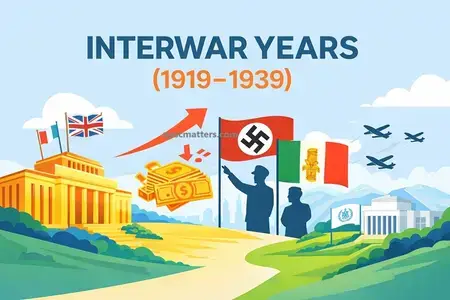
Interwar Years (1919–1939)

Introduction: Interwar Years (1919–1939) The Interwar Years (1919–1939) represent one of the most unstable and decisive phases of modern world history. Instead of ensuring lasting peace, the post–World War I settlement created political, economic, and social conditions that undermined democracies and encouraged aggressive authoritarian regimes. For UPSC aspirants, the interwar period is crucial to understand … Read more
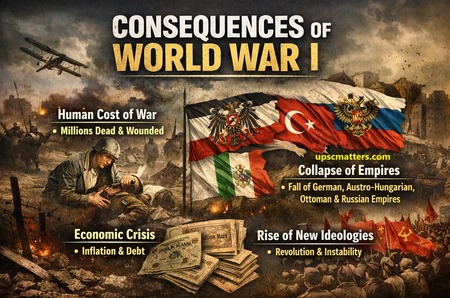
World War I Explained for UPSC: Causes, Course, Impact and Interwar Linkages

World War I

Introduction: Why World War I is Important for UPSC World War I (1914–1918) was a defining turning point in modern world history that reshaped global politics, economies, and international relations. It marked the collapse of old empires, the rise of new ideologies, and laid the foundation for future conflicts, including World War II. For UPSC … Read more

Mahajanapadas in Ancient India: Emergence, Features, Economy, Society and Rise of Magadha.

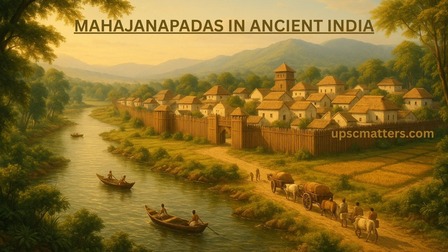
Mahajanapadas in Ancient India

Mahajanapadas in Ancient India:- By the 6th century BCE, India witnessed a major transformation in its political, economic, and social landscape. Small tribal settlements of the Vedic age gradually evolved into larger territorial units known as Mahajanapadas. Spread across the Indo-Gangetic plains and north-western regions, these sixteen states laid the foundation of organised governance, urbanisation, … Read more

Post-Mauryan Era: History, Dynasties, Art, and Cultural Developments

Post-Mauryan Era

Introduction to the Post-Mauryan Era The Post-Mauryan era refers to the period after the fall of the Mauryan Empire (c. 185 BCE), characterized by political fragmentation, emergence of regional powers, increased foreign influence, and cultural synthesis. It acted as a transitional phase between the Mauryan centralized empire and the classical age of the Guptas. Political … Read more

UPSC Essay Paper 2025 – Topics, Analysis & Essay Writing Strategy

UPSC Essay Paper 2025

Check the complete UPSC Essay Paper 2025 with topics from Section A & B, detailed analysis, similarities, and answer writing strategy. UPSC Essay Paper 2025 Write two essays, choosing one topic from each of the following Sections A and B, in about 1000–1200 words each:(125 × 2 = 250 marks) SECTION – A SECTION – … Read more

Difference between Prehistory Protohistory and History

Prehistory Protohistory and History

Understanding the difference between Prehistory, Protohistory, and History is crucial for tracing the evolution of human civilization. These three stages represent how human societies developed over time based on the availability of written records and archaeological evidence. While Prehistory refers to the time before written records, Protohistory marks a transitional phase with limited written evidence, … Read more

Role of Geographical Factors in Ancient India – UPSC Mains Ancient History Notes

Role of Geographical Factors in Ancient India

The role of geographical factors in Ancient India was crucial in shaping its early civilizations, cultural patterns, and socio-economic development. From the fertile river valleys of the Indus and Ganga to the protective Himalayas and resource-rich Deccan Plateau, geography deeply influenced where people settled, how they lived, and how they interacted with their environment. These … Read more

India’s Missile Defense Systems: Key Technologies, Capabilities & Strategic Relevance

Missile Defense Systems

India’s Missile Defense Systems- In an increasingly volatile regional security environment, India’s pursuit of a robust missile defense architecture has gained strategic urgency. With nuclear-armed neighbors like China and Pakistan investing in advanced missile technologies, India has responded by developing and acquiring layered missile defense systems. From indigenous platforms like PAD and Akash to sophisticated … Read more

From Calcutta Madrasa to Sargent Plan: Evolution of Indian Education During British Era | UPSC

Evolution of Indian Education

Evolution of Indian Education- India’s educational landscape underwent a seismic transformation under British rule (1757-1947), evolving from decentralized gurukuls and madrasas into a state-controlled system designed to serve imperial interests. This period – marked by the Anglicist-Orientalist conflict, Macaulay’s radical Anglicization (1835), and Wood’s institutional blueprint (1854) – laid the foundations of modern India’s education … Read more

Collegium System, while safeguarding judicial independence, suffers from opacity and exclusion.

Collegium System

Question- “The Collegium System, while safeguarding judicial independence, suffers from opacity and exclusion.” Critically examine, citing issues like lack of diversity, Uncle Judge Syndrome, and delayed appointments. Introduction- The Collegium System is a judicial innovation developed through Supreme Court judgments (Three Judges Cases), where the judiciary appoints judges to the higher judiciary without executive interference. … Read more

Telegram
WhatsApp
Copy link
URL has been copied successfully!