
Introduction: Why World War I is Important for UPSC
World War I (1914–1918) was a defining turning point in modern world history that reshaped global politics, economies, and international relations. It marked the collapse of old empires, the rise of new ideologies, and laid the foundation for future conflicts, including World War II. For UPSC aspirants, World War I is not merely an event-based topic but a crucial analytical theme that explains the origins of fascism, failure of collective security, and transformation of the international order.
UPSC relevance: Questions are frequently asked on the causes, nature, consequences of World War I, and its role in destabilising the post-war world.
World War I – UPSC Mains PYQs
Ques-“There arose a serious challenge to the democratic state system between the two World Wars.” Evaluate.
Ques-“To what extent can Germany be held responsible for causing the two World Wars?”
Ques-“How far is it correct to say that the First World War was fought essentially for the preservation of balance of power?” These questions indicate that UPSC focuses more on analytical linkages than factual narration.
Causes of World War I
1. Balance of Power & Alliance System-
- By the early 20th century, Europe was divided into two rigid blocs:
- Triple Alliance – Germany, Austria-Hungary, Italy
- Triple Entente – Britain, France, Russia
- The alliance system militarized rivalries and created the mindset that any small regional conflict could escalate.
- Nations believed that alliances ensured security, but instead they created automatic war commitments.
- When Austria-Hungary declared war on Serbia, alliances pulled major powers into war, making WWI inevitable.
- Why this mattered:
- Conflict between two countries became a continental war due to alliance obligations.
- The system destroyed flexibility in diplomacy.
2. Militarism & Arms Race
- Major European powers were engaged in a massive military buildup.
- Germany expanded its army and built a powerful navy; Britain countered with more Dreadnought battleships.
- Military expenditure increased dramatically; Germany and France doubled their armies.
- Military leaders gained political influence, pushing governments towards war rather than negotiation.
Key idea:
- The belief that “war is inevitable” made it a self-fulfilling prophecy.
- Countries prepared for war and therefore chose war when crisis arose.
3. Imperialism and Colonial Rivalries
- Major powers competed for colonies in Africa, Asia, and the Middle East.
- Two important flashpoints:
- Moroccan Crises: Germany vs France over Morocco → increased European hostility.
- Scramble for Africa: Germany felt it was denied colonial opportunities → developed resentment.
- Britain and France grew closer due to shared threats, strengthening the Entente.
Why important:
- Imperial competition created mistrust, suspicion, and hostility, especially between Germany vs Britain & France.
- It laid the psychological environment for war.
4. Nationalism in Europe (Especially the Balkans)
- Nationalism was explosive in the Balkans, the “Powder Keg of Europe.”
- Slavic nationalism, led by Serbia, aimed to unite all Slavs (Pan-Slavism).
- Austria-Hungary opposed Serbian ambitions, fearing disintegration of its empire.
- Russia supported Serbia due to common Slavic identity and its own imperial interests.
Why the Balkans mattered:
- Every Balkan conflict risked triggering the involvement of Austria-Hungary, Russia, Germany, and Britain.
- The region was the geopolitical trigger zone for world war.
5. Immediate Cause: Sarajevo Assassination (28 June 1914)
- Archduke Franz Ferdinand of Austria-Hungary was assassinated by Gavrilo Princip, a Bosnian Serb nationalist.
- Austria-Hungary issued a harsh ultimatum to Serbia.
- Serbia accepted most demands but not all → Austria declared war.
- Russia mobilised to support Serbia → Germany declared war on Russia and France
- Britain joined after Belgium was invaded.
Significance:
- The assassination did not cause WWI alone; it simply activated a system already primed for war.
6. Germany’s Role – Weltpolitik & Naval Race with Britain
Germany’s aggressive foreign policy (Weltpolitik) under Kaiser Wilhelm II aimed to:
- Expand colonies
- Build a global navy
- Position Germany as a world power
- This alarmed other countries, especially:
- Britain, due to Germany’s naval expansion.
- France, because of German hostility after 1871.
Naval Race:
- Germany built a fleet to challenge Britain’s Royal Navy.
- Britain responded with the revolutionary Dreadnought battleships.
- The naval arms race destroyed traditional Anglo-German friendship and pushed Britain closer to France and Russia.
Why Germany is often blamed:
- Its policies destabilized the existing balance of power.
- Many historians view Germany as a “revisionist” power.
7. Failure of Diplomacy
- Multiple crises between 1905–1914 (Morocco, Bosnia, Balkan Wars) were resolved temporarily, but no lasting settlement was achieved.
- Diplomacy failed because:
- Powers did not trust each other.
- Military influence over politics increased.
- Alliances reduced room for negotiation.
- Decision-making was impulsive and poorly coordinated.
Examples of diplomatic failure:
- Germany gave Austria a “blank cheque” of support after Sarajevo.
- Russia mobilised without clear communication.
- Britain maintained an ambiguous stance until Germany invaded Belgium.
Why diplomacy collapsed:
- Leaders believed a short war was preferable to long-term tension.
- Miscalculations pushed Europe from crisis to catastrophe
Nature, Course & Impact of World War I
1. Why World War I became a global war & a total war
A. Why it became a global war
World War I spread beyond Europe because:
a) Colonial Empires Involved
- Britain, France, Germany, and Russia had vast colonial empires in Asia, Africa, and the Pacific.
- Troops from India, Africa, Australia, Canada, New Zealand fought on European fronts.Battles occurred in Africa, Middle East, Pacific islands, making it a global conflict.
b) Alliances brought in all major powers
- Triple Entente vs Triple Alliance meant conflict among great powers, not just regional states.
- Once Austria-Hungary and Serbia clashed, other nations entered due to alliance obligations.
c) Strategic Interests Worldwide
- Germany attacked British and French colonies.
- Japan joined the Allies and captured German possessions in China and Pacific.
d) Naval warfare on high seas
- German U-boats attacked ships across the Atlantic and Indian Ocean.
- Even neutral countries were affected.
Conclusion: The interconnected imperial world order ensured that a European war became a world war.
B. Why it became a total war
World War I was the first “total war” because:
- Entire societies were mobilised
- Millions of soldiers were conscripted.
- Women entered factories, farms, and war industries.
- Massive state control- Governments controlled prices, rationing, food supply, and industrial output.
- Economic resources fully redirected-
- Industries shifted to producing shells, tanks, weapons.
- Civilian consumption drastically reduced.
- Targets included civilians
- Blockades caused starvation (e.g., German civilians suffered heavily).
- Bombings affected civilian towns.
- Propaganda & censorship- Governments controlled media, shaped public opinion, and prosecuted dissent.
Conclusion: WWI blurred the line between frontline and home front, making society as a whole part of the war effort.
2. Major Battles & Innovations in Warfare
A. Major Battle-
- Battle of the Marne (1914)- Stopped German advance toward Paris; ended hopes of quick victory.
- Battle of Verdun (1916)- One of the longest and bloodiest battles between Germany and France.
- Battle of the Somme (1916)- Massive casualties; first use of tanks.
- Eastern Front Battles (Tannenberg, Masurian Lakes)-Germany defeated Russia decisively.
- Middle East & Africa-Lawrence of Arabia inspired Arab revolt against Ottoman Empire.
B. Innovations in Warfare-
- Trench Warfare
- Long defensive trenches stretching hundreds of kilometers.
- Resulted in stalemate, massive casualties, and harsh living conditions.
- Machine Guns- Made traditional infantry charges suicidal.
- Tanks- First used by Britain in the Battle of the Somme. It broke stalemates later in war.
- Poison Gas- Chlorine and mustard gas used by both sides. It led to gas masks becoming standard equipment.
- Submarines (U-boats)- Germany used submarines to attack Allied shipping. U-boat attacks on American ships helped bring USA into the war.
- Air Warfare- First use of aircraft for reconnaissance, bombing, and dogfights.
- Heavy artillery & barbed wire- Artillery caused the majority of casualties.
Expected Ques: “WWI became a highly mechanized, destructive war unlike any previous conflict.“
3. Human & Economic Consequences
A. Human Consequences
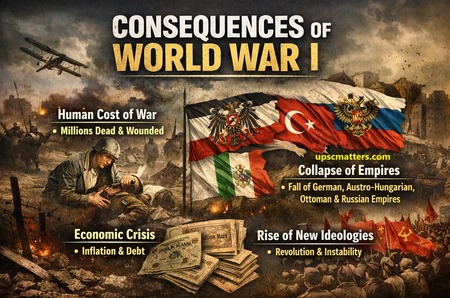
- Unprecedented casualties: Around 9–10 million soldiers killed. 20+ million injured. Millions of civilians died due to blockade, famine, and disease.
- Lost generation of young men.
- Psychological trauma (“shell shock”) widespread.
- Refugee crises in Eastern Europe and Middle East.
B. Economic Consequences
- Huge economic exhaustion of Britain, France, Germany, Russia.
- Massive war debts → US emerged as world’s biggest creditor.
- Inflation and shortages across Europe.
- Infrastructure destruction on Western Front.
- Collapse of international trade.
- Post-war reconstruction imposed huge burdens on economies.
- Germany faced crippling reparations after Treaty of Versailles.
Conclusion: Europe lost its global economic dominance; USA and Japan rose.
4. Political Changes – Collapse of Four Major Empires
A. Fall of the German Empire
- Kaiser Wilhelm II abdicated (1918).
- Germany became a republic (Weimar Republic).
- Humiliation & instability → fertile ground for rise of Hitler.
B. Fall of the Austro-Hungarian Empire
- Multi-national empire disintegrated.
- New states created: Austria, Hungary, Czechoslovakia, Yugoslavia.
- Central Europe restructured → ethnic tensions lasted for decades.
C. Fall of the Ottoman Empire
- Lost Arab territories (Iraq, Syria, Palestine, Jordan) to Allied mandates.
- Led to creation of modern Turkey under Atatürk.
- Middle East borders drawn artificially → long-term conflicts.
D. Fall of the Russian Empire
- Russian Revolution (1917) toppled Tsar Nicholas II.
- Bolsheviks took power → created the Soviet Union (USSR).
- Russia withdrew from war (Treaty of Brest-Litovsk).
Consequences of WWI
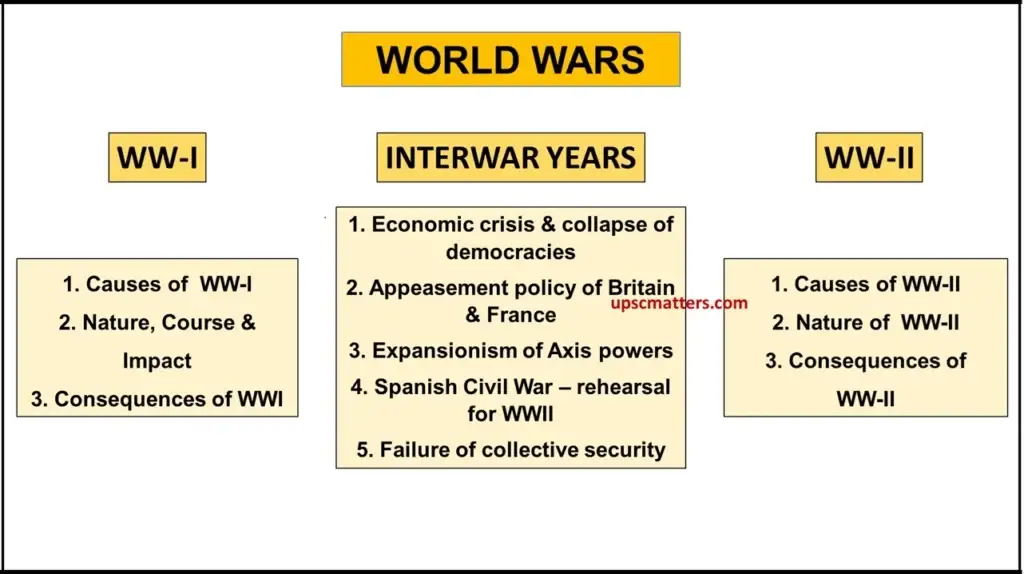
Topic is Important for linking WWI → WWII
1.Treaty of Versailles – provisions, consequences, why it failed
2.League of Nations – successes, failures, structural weaknesses
3.Rise of totalitarian regimes
- Fascism in Italy
- Nazism in Germany
- Militarism in Japan
- Great Depression (1929) and its global political impact
These areas help you answer Ques: “There arose a serious challenge to the Democratic State System between the two World Wars.”
1. Treaty of Versailles – Provisions, Consequences, Why it failed
A- Provisions
1) Territorial Provisions
- Germany lost 13% of its territory and all overseas colonies.
- Alsace-Lorraine returned to France.
- Polish Corridor created; Danzig made a free city.
- Rhineland to be demilitarized.
2) Military Restrictions
- German army capped at 100,000 soldiers.
- No tanks, submarines, air force.
- Navy restricted to a few ships.
3) Reparations
- Germany held fully responsible for war (Article 231 – War Guilt Clause).
- Huge reparations imposed (later fixed at 132 billion gold marks).
4) Political Provisions
- League of Nations established.
- Germany barred initially from membership.
B. Consequences
1) Economic Hardship
- Reparations → inflation, poverty, unemployment.
- Middle class savings destroyed → radicalisation.
2) Political Instability
- Weimar Republic seen as “traitor regime.”
- Nationalists and extremists (Hitler) gained popularity.
3) Growth of Revanchism-
- Harsh treaty made Germans demand revenge.
- Revisionism became central to German foreign policy.
4) Redrawing Europe map
- New states (Poland, Czechoslovakia, Yugoslavia) created.
- But many minorities placed in wrong states → ethnic tensions later.
C. Why the Treaty Failed
1) Too harsh to be accepted
- Created permanent resentment in Germany.
- Germans viewed it as “Diktat.”
2) Too weak to prevent future war
- Allies failed to enforce disarmament fully.
- Germany secretly rearmed in 1920s–1930s.
3) Unworkable economic burden- Reparations unrealistic; Germany defaulted repeatedly.
4) Revisionist powers exploited it- Hitler used treaty grievances to mobilize support and justify aggression.
Ques-The Treaty of Versailles sowed the seeds of the next war.
2. League of Nations – Successes, Failures & Structural Weaknesses
A. Successes
1) Humanitarian Achievements- Worked against slavery, drug trafficking, and improved labour rights.
2) Settled Minor Disputes
- Between Sweden–Finland (Aaland Islands).
- Between Greece–Bulgaria (1925).
- Managed refugees after WWI.
3) Mandate System- Oversaw administration of former Ottoman and German colonies.
These successes were limited and did not involve major powers.
B. Failures
1) Manchuria (1931)
- Japan invaded Manchuria.
- League condemned but took no action.
- Japan withdrew from League.
2) Abyssinia (1935)
- Italy invaded Ethiopia.
- League imposed weak sanctions; Britain and France avoided confrontation.
- Italy left League.
3) Failure to stop Hitler
- No action on German rearmament.
- No response to remilitarisation of Rhineland (1936).
- Appeasement flourished.
C. Structural Weaknesses
1) No enforcement power- No army; relied on moral persuasion.
2) Absence of major powers
- USA never joined.
- USSR joined late (1934–40).
- Germany, Japan, Italy withdrew.
3) Decisions required unanimity- Made it ineffective and slow.
4) Dominated by Britain & France- Both were war-weary and economically weak.That’s whyavoided tough actions.
Ques – “League of Nations was a noble idea but structurally flawed and politically unsupported.”
3. Rise of Totalitarian Regimes
Origins
- Italy felt “cheated” at Versailles (didn’t get promised territories).
- Economic crisis, unemployment, worker unrest.
- Fear of communism among elites.
Rise of Mussolini (1922)
- Promised order, national pride, anti-communism.
- Marched on Rome; King invited him to form government.
Features of Fascist State
- One-party dictatorship.
- Militarism, nationalism, imperialism.
- Expansionism → invasion of Ethiopia (1935)
Nazism in Germany
Origins
- Treaty of Versailles humiliation.
- Hyperinflation (1923), Great Depression (1929).
- Weak Weimar Republic.
Rise of Hitler (1933)
- Promised to restore Germany’s glory.
- Used propaganda, paramilitary groups, anti-Semitism.
- Became Chancellor; established dictatorship.
Features of Nazi State
- Totalitarian, racist, anti-Semitic.
- Re-armament and territorial expansion:
- Remilitarised Rhineland
- Annexed Austria (Anschluss)
- Took Sudetenland & Czechoslovakia
- Invaded Poland → WWII
Militarism in Japan-
Origins
- Economic crisis after Depression.
- Dependence on imports → desire for resource-rich colonies.
- Weak civilian governments.
Rise of Military Rule
- Military leaders gained control.
- Expansionist ideology “Greater East Asia Co-Prosperity Sphere.”
Aggressive Expansion
- Invaded Manchuria (1931).
- Full-scale invasion of China (1937).
- Joined Axis Powers (1940).
Ques: “Economic distress, national humiliation, and fear of communism created conditions for authoritarian regimes.“
4. Great Depression (1929) & Its Global Political Impact
A. Causes
- US stock market crash.
- Overproduction, falling demand.
- Bank failures and collapse of credit.
- Decline in global trade.
B. Impact on World Politics
1) Collapse of Democracies
- Economic misery led people to reject weak democratic governments.
- Fascist and Nazi parties exploited unemployment and poverty.
2) Rise of Militarism
- Japan turned to military conquest for resources.
- Germany rearmed to reduce unemployment.
3) End of International Cooperation
- Nations adopted protectionism and beggar-thy-neighbour policies.
- League of Nations became irrelevant.
A Beggar-thy-Neighbour Policy –
It is an economic strategy where a country tries to boost its own economy (e.g., by reducing unemployment) at the direct expense of other nations, often through protectionism like tariffs, quotas, or currency devaluation, essentially making its neighbours “beggars” for economic well-being. These measures aim to shift demand towards domestic goods but typically trigger retaliatory actions, hurting overall global trade and leading to economic conflicts.
4) Radicalisation- Extreme ideologies gained mass support (Nazism, Fascism, Communism).
5) Increased Tensions
- Japan expanded in Asia.
- Italy invaded Ethiopia.
- Germany expanded aggressively in Europe.
Ques: The Depression transformed an economic crisis into a political crisis, destabilizing democracies and enabling dictatorships.
Conclusion: Relevance of World War I for Contemporary World Politics
World War I fundamentally altered the course of world history by dismantling empires, destabilising political systems, and exposing the limitations of diplomacy and collective security. The war’s unresolved legacies—particularly the Treaty of Versailles and economic disruptions—fuelled authoritarianism and led to World War II. For UPSC aspirants, understanding World War I is essential to analyse later global developments such as fascism, the Cold War, decolonisation, and the evolution of international institutions.
If you found this helpful, you might also like these articles:
[https://upscmatters.com/indus-valley-civilization/ ]
[https://upscmatters.com/buddhism-a-complete-guide-for-upsc-history/]
[https://upscmatters.com/advent-of-europeans-in-india-arrival-expansion/]
They cover key concepts that will boost your preparation!
Stay Updated with the Best UPSC Resources!
Join our Telegram Channel for:
Daily Current Affairs
Important Notes & PDFs
Answer Writing Tips
Strategy & Motivation
Click the link to join now: [https://t.me/upscmatters] or [https://t.me/ramsirnotes]
Don’t miss out on valuable updates!



1 thought on “World War I Explained for UPSC: Causes, Course, Impact and Interwar Linkages”